
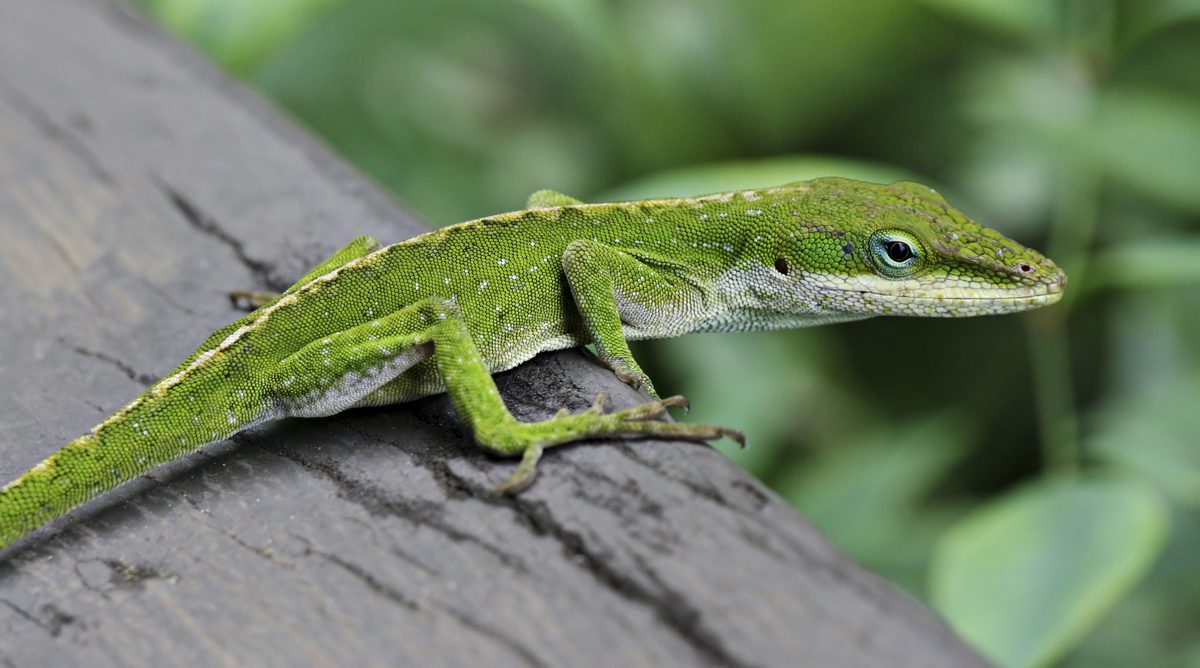

In a stand of trees no bigger than a backyard, in the warm green edge of the southeastern United States, one small lizard claimed the whole place as his own.
He was a green anole, barely the length of a finger, and his entire territory could be walked in under a minute by anything with legs longer than his.
It was enough. It was everything he needed.
He had toe pads built for climbing, fine enough to grip a leaf, a twig, even the smooth bark of the tree he favored most, and from a branch near the top of it, he could see every edge of his small green world.
Most mornings, nothing crossed those edges at all.
He hunted anyway, quick and quiet, snapping up spiders and small insects among the leaves, and when the sun found him at the right angle, his whole body glowed the bright green of a new leaf.
Then, one warm afternoon, another male appeared at the far side of the yard.
He did not wait to see what the stranger wanted.
He rose onto his front legs and pushed himself up and down, up and down, a small steady beat against the bark. Then, under his chin, a fold of skin he had carried all his life unfurled into a flag of pink, bright as any bloom nearby, held out for exactly as long as it took to be seen.
The stranger paused.
He held his ground and bobbed his head, once, twice, a signal older than either of them, and by the second bob his green had begun sliding toward brown, the way it did whenever his blood ran hot with the moment.
The stranger looked a while longer, weighed a tree he had not yet claimed against a fight he did not need, and turned back the way he had come.
No claws. No chase.
Only a flag, and a color, and a small patient standoff that ended the way these things usually do among his kind, without a single scratch.
By evening, he had faded back to green and returned to hunting, calm again, the border quiet again.
Through the warm months, he mated when a female crossed his branch, and she laid her eggs one at a time, tucked singly into soft soil at the base of his tree, over and over through the whole long season, never all at once.
Once, a bird's beak came down fast and caught only his tail, and he left it behind without slowing, already three branches away and already growing a new one, slower and plainer than the first, but enough to balance on.
He never weighed his few trees against the wide world beyond them.
He only knew his own branches, in every green and every brown he had ever worn, and the pink flag folded and ready beneath his chin for the next stranger who needed to see it.
Some places are small enough to hold with nothing but color and patience.
His always had been.