
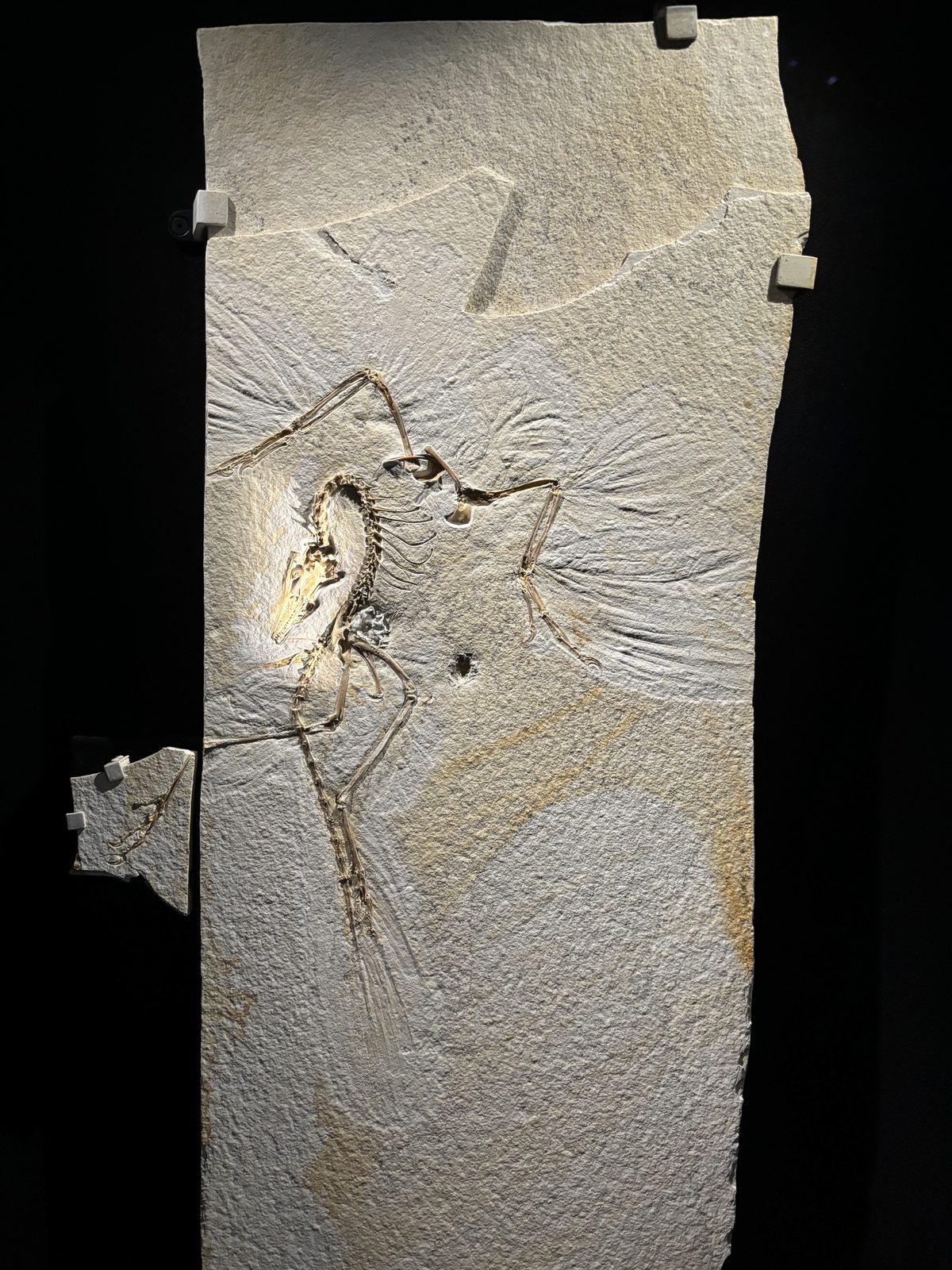

Something about her did not fit.
The small, sharp toothed hunters who shared her patch of lagoon shore ran everywhere on quick legs, tails out straight behind them for balance, and never once left the ground.
She could run like that too. But she also had feathers, long ones, laid out in a fan along each arm, and something in her wanted to use them for more than warmth.
Above the lagoon, leathery winged pterosaurs rode the sea wind on the far side of the water, gliding for what looked like the sheer pleasure of it.
She was not built like them either.
Nobody paid her much attention either way.
She was about the size of a crow, easy to miss among the ferns and low cycads at the edge of the mud flats, with clawed fingers at the bend of each wing for gripping branches, and a long bony tail trailing out behind her like something borrowed from an older, ground bound cousin.
One morning she climbed the twisted trunk of a low conifer, claws finding their grip the way a lizard's would, and from partway up she watched a dragonfly cut past just out of reach.
She had chased insects like that before, on foot. Not this time.
She spread her feathered arms, dropped from the branch, and beat them, hard, once, twice, and felt the air push back against her the way water pushes back against a swimming fish.
It was not much of a flight, if it was truly a flight at all. A short, low glide, ending in a scrambling grab that closed around the dragonfly before both of them tumbled into the ferns.
But it was enough.
The pterosaurs overhead did not notice. The little ground hunters never looked up. Only she knew what her own arms had just done, and she did it again the next day, a little further, a little higher off the branch each time.
She was not quite one of the sharp toothed runners anymore.
She was not quite a pterosaur either.
She was the place where one kind of animal was quietly becoming another, and she carried on exactly as she always had, hunting insects at the edge of a warm and ordinary lagoon, with no idea that anyone, ever, would think that mattered.
One still day, close to the water, her strength simply left her, gently, the way it does at the end of a long life, and she settled into the soft grey mud at the lagoon's edge.
The mud kept her exactly as she had been. Every feather. Every claw. The long tail, laid out behind her one last time.
About 150 million years later, someone found her in a slab of pale limestone, and lifted the stone into the light, and saw, pressed there in perfect grey detail, wings.
She had never known what to call herself.
Now everyone else would spend a very long time trying to.