
Somewhere in the cool wet mountains of northern Madagascar, under leaves that never stopped falling, there lived a hunter no bigger than a raindrop.
He would not have called himself small. He was exactly as big as he was supposed to be.
But the forest around him did not agree.
A single fern frond, to him, was a green sky. A puddle after rain was an ocean he dared not cross. A beetle, ambling past, was as tall as a house.
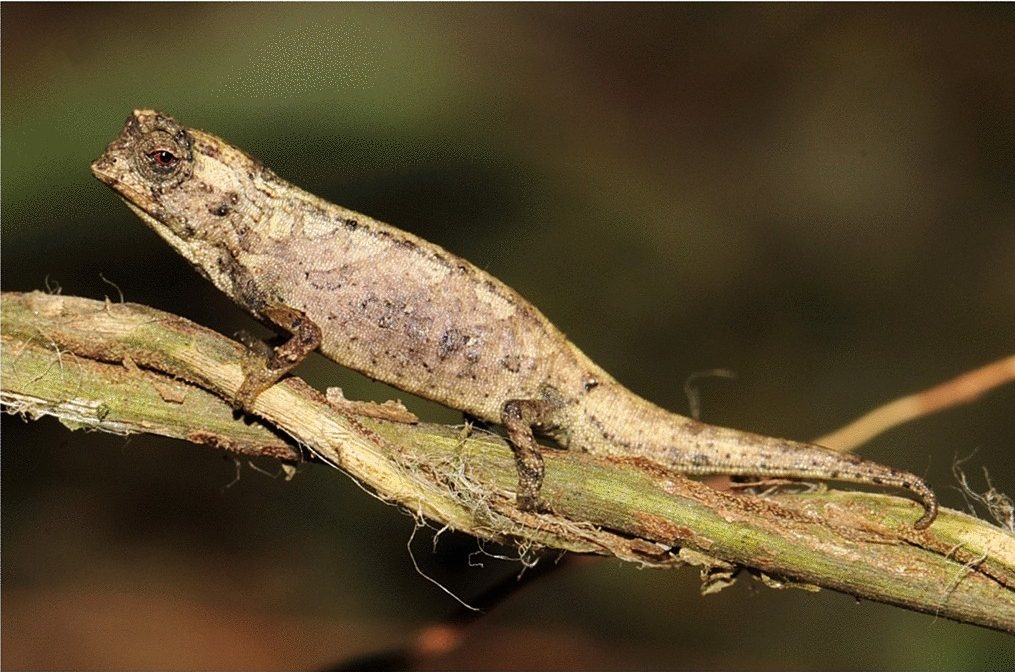
He was brown, the same brown as the leaf he sat on, the brown of things that have already fallen and are done falling. Not because he chose the color that morning. That was simply what he was, all the time, dead-leaf brown, and it hid him the way stillness hides a shadow.
He waited.
Waiting is most of a small hunter's work.
A mite crossed the leaf a finger's width away, feeling its way over the veins as if they were roads. He watched with eyes that barely moved, and when the mite came close enough, his tongue found it before the mite had a chance to notice him at all.
One mite.
Then the long wait for the next one.
Some mornings a springtail bounced through the leaf litter like a spark, there and gone, and he had to be faster than thought to catch it. Some mornings nothing came at all, and he sat on his leaf and let the mist settle on him in small grey beads, patient as the mountain itself.
He was looking for something besides food, though he could not have said so in words. He was looking for another of his kind.
One afternoon, working his way along a fallen branch that felt, to him, as long as a road, he found her.
She was on a low leaf, and he knew her at once, though she was a little larger than he was, the way the females of his kind always are. She did not turn to color for him. She had no bright flash to offer, no shifting rainbow the way the big chameleons in faraway trees are famous for. She simply held still, dead-leaf brown, exactly as he was, and let him come closer.
There was no performance in it. Only two small, careful lives, meeting in a place the size of a dinner plate, in a forest that went on for a hundred kilometers around them without ever noticing either one.
That was enough.
Later that year, deep in the same mountain forest, people arrived with soft brushes and glass jars and patient hands, looking for the smallest things a forest could hide. They searched the leaf litter the way he had always searched it, low, slow, and close to the ground.
When they found him, they held him the only way that made any sense.
On the tip of one finger.
Tail and all, he did not reach the first knuckle. The finger barely felt the weight of him, and yet there he was, whole, complete, undeniably a life: a hunter, a survivor of a hundred mist-grey mornings, one of the smallest reptiles this forest, or any forest, had ever produced.
He did not know he was the smallest reptile anyone had ever found. He only knew the leaf beneath him, and the mist, and, somewhere close by, a much larger brown shape that was, in its own quiet way, entirely his.
A kingdom does not need to be big.
It only needs someone small enough to see all of it at once.