
_Moorea.jpg)
Blue, in every direction, forever.
That is the open ocean. No signposts. No street names. No helpful crab holding an arrow that says THIS WAY.
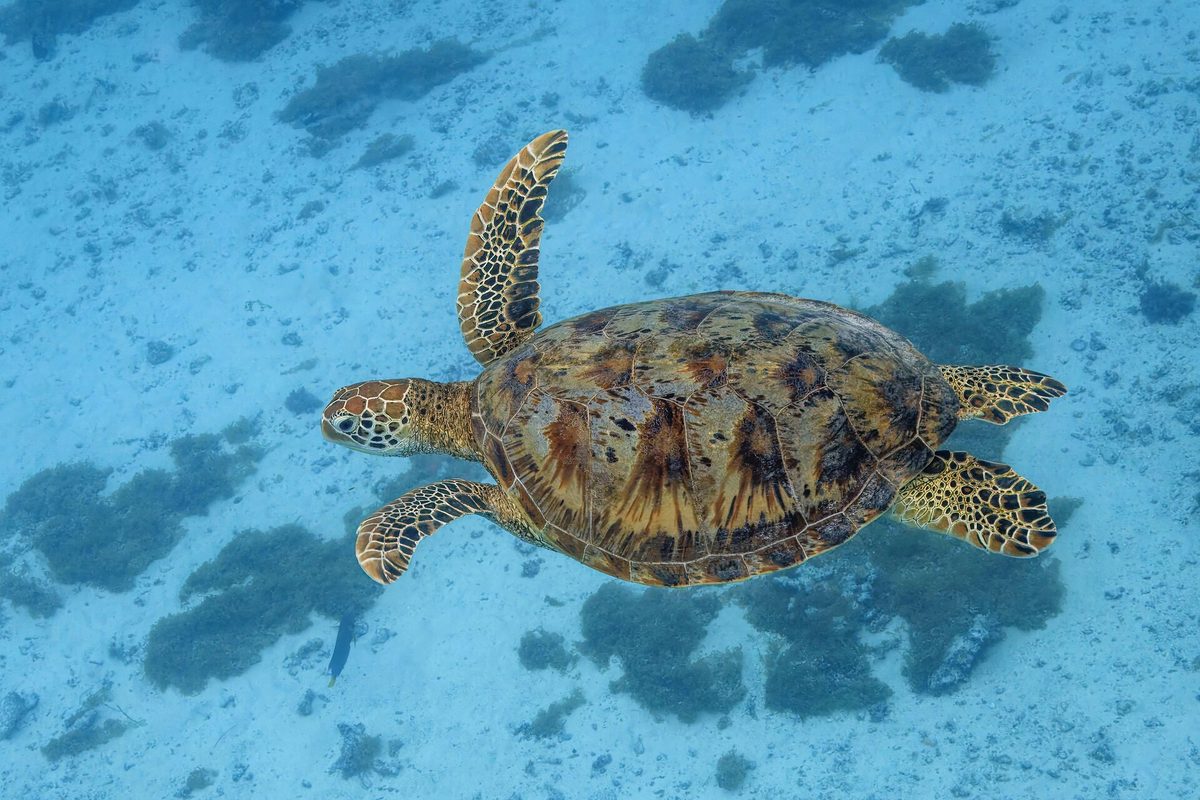
And yet, one bright morning, in a seagrass meadow off the coast of Brazil, a green sea turtle lifted her head from breakfast and felt something tug.
Not a current. Not a wave. A pull, deep inside her, quiet as a compass needle turning.
She had lived in that meadow for years. She grazed the seagrass in tidy rows, like a gardener trimming a lawn, and her trimming kept the whole meadow thick and green and healthy. She rested on the sandy bottom for hours at a time, holding her breath the way she held her patience: easily.
It was a good life.
But now the pull was awake, and it pointed out to sea.
"Where are you going?" asked a little fish who lived near her favorite rock.
"Home," said the turtle.
"Which way is home?"
The turtle turned her beak toward the empty blue. "That way."
"How can you tell?"
"I just can."
Here is a secret, and it is yours to keep: a green sea turtle carries a map inside her. She can feel Earth's magnetic field, the invisible lines that wrap around our whole planet, and somewhere on her map one beach is marked with an X. The beach where she hatched. The beach she never forgot.
So she swam.
Days passed. Then weeks. She crossed about 2,000 kilometers of open Atlantic, flying underwater on flippers like long green wings. Storms rolled across the sea, and she slid calmly beneath them. The pull stayed steady the entire way.
Then, one evening, a smudge on the horizon.
An island. A speck of rock and sand in the middle of the enormous ocean, sitting exactly where her map said it would be.
She waited for the dark. Then she hauled herself up the beach, suddenly heavy, because a turtle who flies in water must crawl on land. With her back flippers scooping like careful spoons, she dug a deep nest. She laid about a hundred round white eggs, each one the size of a ping pong ball, with a shell as soft as leather.
She covered them with warm sand and patted it smooth.
Salty tears rolled from her eyes. Sea turtle eyes make tears all the time, to wash away extra ocean salt, so she felt perfectly fine. But anyone watching in the moonlight would have sworn she was crying for joy.
Maybe, in her own quiet way, she was.
By sunrise she was back in the waves.
And in about two months, under some patient moon, tiny turtles would scramble out of that same sand and race down that same beach into the sea, each one carrying the same invisible map, with the same X already glowing on it.
Home is like that, for a green sea turtle.
She can cross an entire ocean, and the whole way there, home rides quietly inside her.