Frill_neck_lizard.jpg)
The cicadas stopped singing all at once.
In the savanna woodlands of northern Australia, that only happens for a reason.
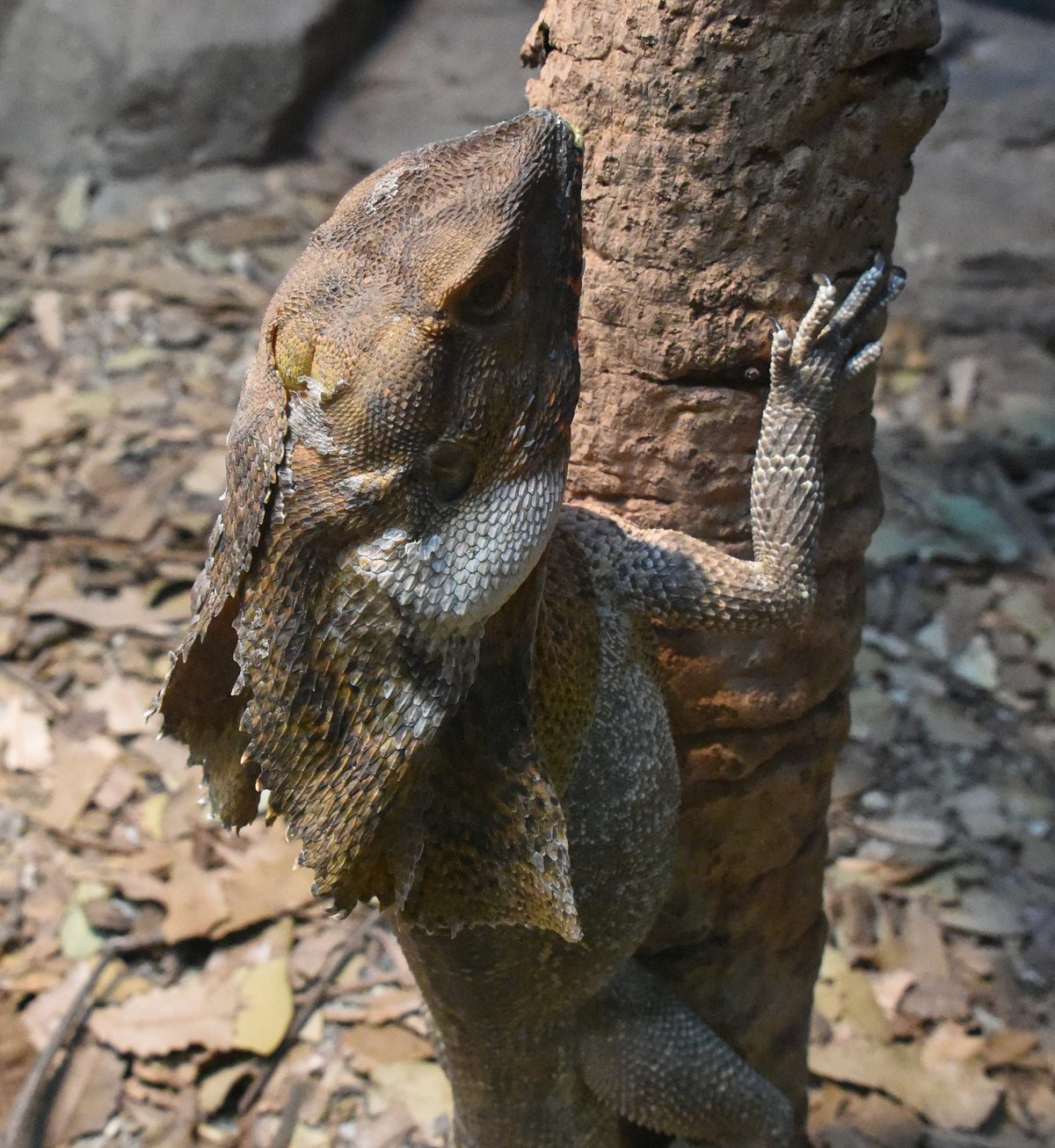
High in a stringybark tree, a young frilled lizard named Pinta held still. She was about 60 centimetres long, and most of that was tail. Around her neck lay her famous frill, folded flat, like a cape she was saving for later.
Below her, the ground glittered with breakfast. Rain had fallen in the night, and the termites were swarming out of their mounds. Through the long dry season Pinta had stayed high in the trees and eaten almost nothing. This was the feast her whole year leaned on.
She listened.
Nothing moved.
Then something did.
A dingo trotted out of the yellow grass, nose down, ears up, reading the ground like a menu.
Pinta thought it over, the way small animals must. The dingo was far. The termites were near. And a frilled lizard cannot grow strong on caution.
She crept down the trunk, keeping the tree between them. Then she was on the ground, snapping up termites. One. Ten. Fifty. Her jaws worked like a tiny, happy machine.
The dingo's ears turned.
Then the dingo turned.
It came fast and low through the grass, and suddenly the nearest tree stood very far away.
Pinta did the mathematics of small creatures. Too far to run. Too small to fight.
Time for the cape.
She whipped around to face the dingo and opened her mouth as wide as it would go. Rods of cartilage, joined to her jaws, pulled the frill open with them. The folded cape burst into a blazing collar wider than a dinner plate, with a wide yellow mouth at the centre of it. She hissed. She swayed. She lunged at an animal many times her weight.
The dingo stopped.
For two whole heartbeats it stared at this brand new creature, this hissing sun with teeth.
Two heartbeats was all she needed.
Pinta spun, rose onto her back legs, and ran. Upright, tail swinging for balance, feet drumming the wet earth, all the way to the stringybark and up into the high branches, where she pressed flat and melted against the bark.
Below, the dingo shook its head and trotted off to find a breakfast that did not explode.
Pinta folded her frill away and caught her breath. The cicadas started again, first one, then thousands, and the woodland went back to being hot and loud and alive.
Here is the part worth keeping. The trick worked because Pinta committed to it, every scale of her. Being brave, it turns out, is mostly looking brave for two heartbeats longer than your fear.
Australians grew so fond of this little bluffer that they stamped its portrait on a coin.
A whole country, carrying a small lizard's courage in its pocket.