
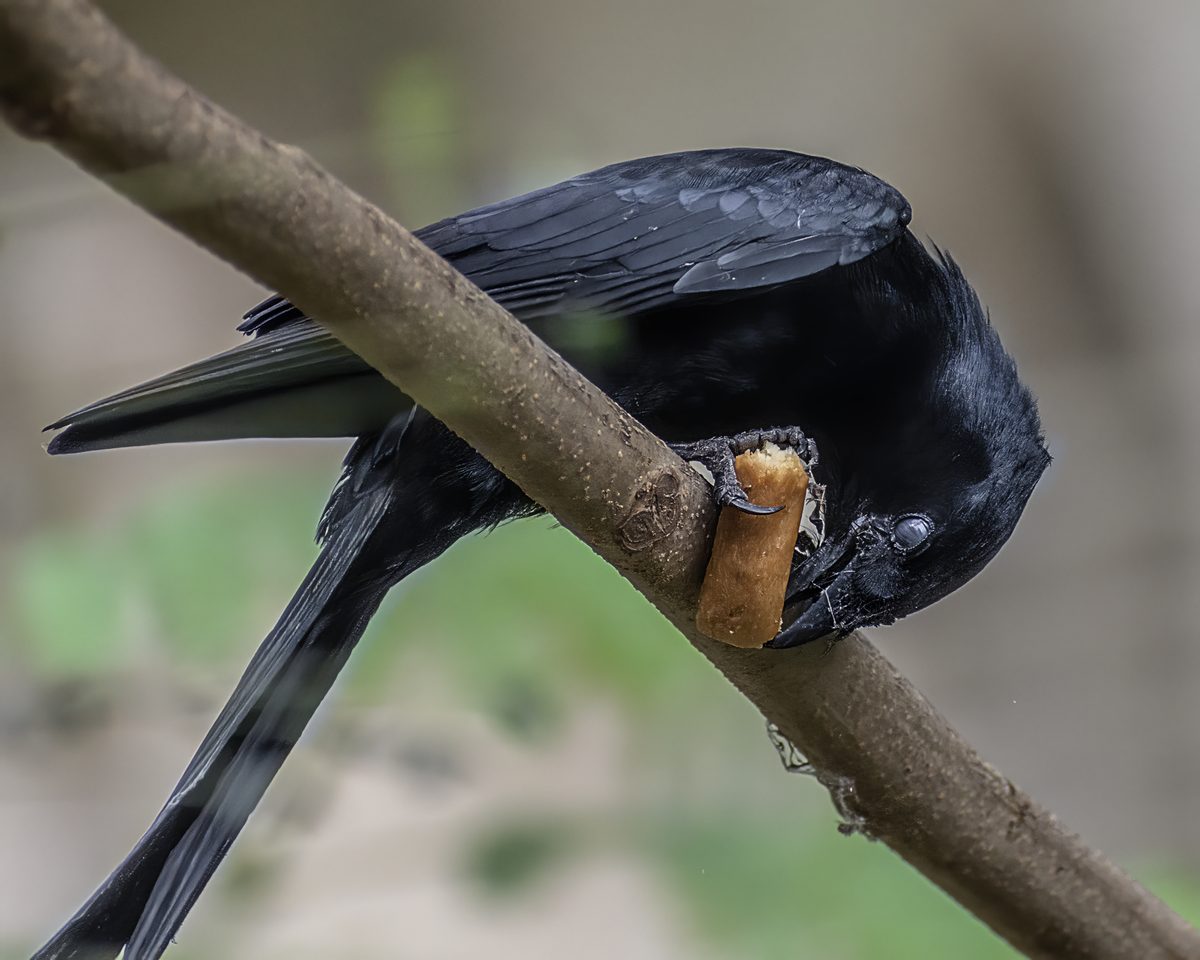

Somewhere in the forest canopy of New Caledonia, a grub was hiding exactly where nothing should have been able to reach it.
Deep in a narrow hole. Down where a beak alone could never go.
The young crow, all black feathers and a straight, careful bill, had watched her mother solve this same problem a hundred times, and she still did not understand how.
Stage one: she tried her beak alone, jabbing at the hole, and came away with nothing but bark dust.
Nobody was watching. Nobody needed to be. The hole kept its grub, and she kept her hunger.
Her mother, perched close by, tore a strip from the spiky edge of a pandanus leaf. Not torn wildly. Torn with care, along one straight line, until a small hooked point curled at the end like a question mark. She slid it into the hole, twisted, and drew out the grub, calm as anything.
The young crow watched the whole motion twice more before she tried it herself.
Stage two: her first hook came out crooked, caught on nothing, and snapped. Her second was better, close enough to reach the grub, not close enough to hold it. Her mother did not help. She only stayed nearby, tearing her own tool, patient, letting the lesson happen at its own pace.
A year is a long apprenticeship for a bird. The young crow spent most of it failing quietly where no one but her family could see.
Then, on an ordinary morning, she chose her own leaf.
She tore along the edge slowly, feeling for the place where the spikes wanted to curl, and a small neat hook appeared under her claws, almost by itself.
She carried it to the hole.
Stage three: the hook went in, caught, and held. The grub came free into the morning light, and for a moment the young crow simply sat there, holding her own tool in one foot, understanding for the first time what a year of watching had actually taught her.
She did not throw the hook away.
She tucked it under her foot, the way her mother always tucked her favorite one, and carried it with her to the next tree, and the one after that, keeping it the way another animal might keep a good pair of hands.
She has solved harder puzzles than this one before: a stick that reaches a stone, a stone that reaches a treat, each part useless without the one before it. Nobody taught her the shape of that patience. She found it the same slow way she found her first good hook.
Now when she flies from tree to tree, she carries more than feathers and a straight black bill.
She carries a small bent leaf, curved exactly right, and everything her mother ever showed her, folded quietly into the shape of a single hook.