
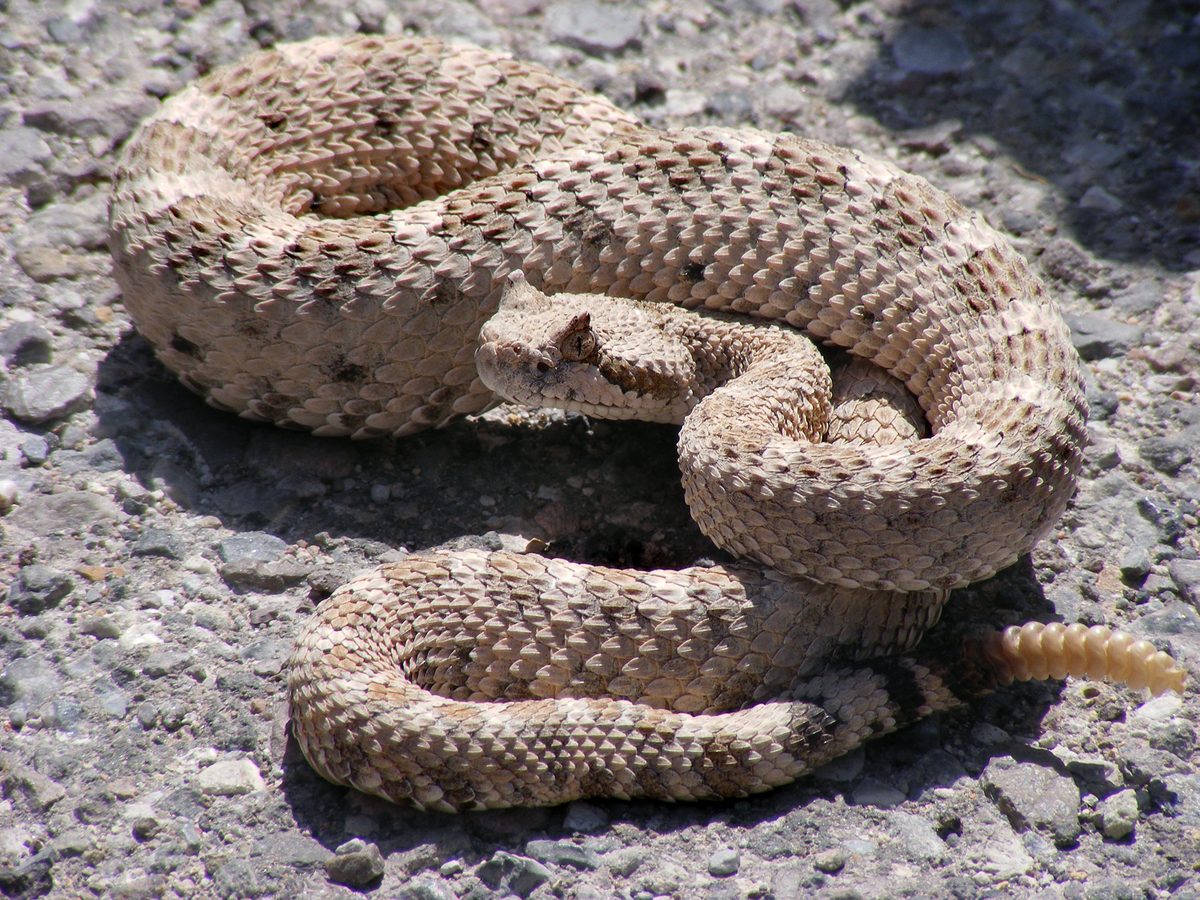

Something impossible lay between the sidewinder and her supper.
A stretch of open dune, bald and pale, with no shade and no path across it, only heat that had been building since noon.
She was small, even for a rattlesnake. About the length of a grown man's arm, no more. The kangaroo rats on the far side of the dune had never once looked her way.
No one made room for a snake so small.
But evening was coming, and evening changed everything.
She had spent the bright hours buried, only her eyes above the sand, two small hills of horn shading them from the glare like a visor built for exactly this desert and nowhere else. Above the horns, nothing. Below the sand, everything cool.
Wait.
Watch.
Let the sun go down.
When the light finally softened to violet, she lifted her head and felt the sand still holding the day's heat, more than her skin could bear for long. A lizard could dash across it in short bursts, resting wherever it found shade. She had no such luxury out on open dune.
So she did not walk. She threw herself sideways, in loops, one curve of her body landing while the rest lifted clear of the sand, and for one heartbeat only two small parts of her touched anything hot at all. Then those two parts lifted too, and two new ones landed, further along.
Not a straight line. A row of separate marks, each shaped like a small letter J, laid one after another across the dune like stitches across cloth.
She never gave the sand enough of herself, or enough time, to burn her.
Halfway across, something warm moved in the dark ahead, a shape her eyes could barely find but that the small pits beside her nostrils felt as clearly as a hand held near a candle. A kangaroo rat, out foraging, trusting that open dune kept it safe from anything that hunted by daylight.
It had never met a hunter built for night.
She closed the distance in loops, quiet as falling sand, and the hunt ended the way small hunters end it, quickly, without a sound carrying far enough to worry the rest of the dune.
Full again, she recrossed the sand toward the rocks where she would coil until morning. Behind her, the loops of her trail lay printed clean across the dune, a whole path written in matching J's, each one pointing the same way, like punctuation with nowhere else to be.
By sunrise the wind had already begun smoothing them away.
It did not matter. She had never crossed that dune to leave a signature. She had crossed it to eat, and to prove nothing to the kangaroo rats who had never looked her way, and never would.
Small still worked. It had always worked.
Under the next rock she coiled, only her eyes above the sand again, horns raised like a visor against a sun that had not yet returned, and somewhere out on the smoothing dune, the last J of the night filled slowly in with wind.