_male.JPG)
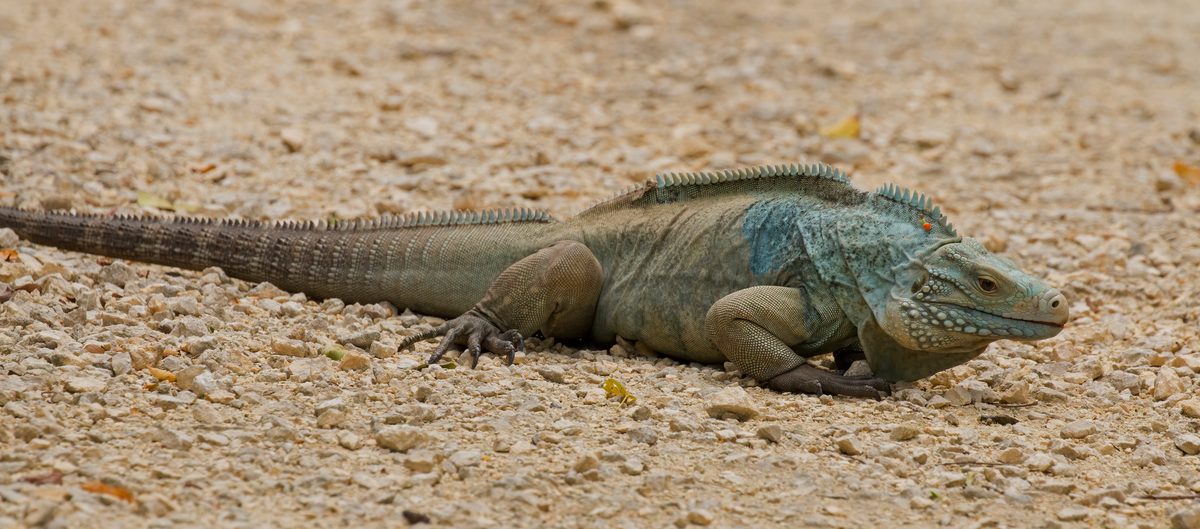
An old iguana on Grand Cayman used to turn a color into the hills, and for a long time, nothing turned it back.
Something was wrong on the rock she loved best.
Not a sound. A color.
Grand Cayman is a small island, and in the quiet years she had most of it to herself, or so it seemed on the mornings she climbed the limestone shelf above the forest and let the sun find her.
The sun did its work slowly. Gray. Green. Then, at last, blue. A deep, calm, unmistakable blue, rising through her skin the way morning rises through a sky.
It was her breeding season signal, and it was also her warning. This rock is mine. I am here.
She held that blue toward the far ridge and waited for an answer.
None came.
Not that dry season. Not the one after.
She was not foolish about why. Roads had come closer, and roads carried cars that did not slow for a lizard crossing at dusk. Dogs found burrows that iguanas had kept safe for a hundred years. Cats found the smallest and the softest first. The forest that had always answered her blue had gone, mostly, quiet.
So she did what a blue iguana does. She kept living exactly as she always had.
She ate the same food she always had, sea grape leaves, the soft drop of ripe fruit, the yellow flowers that opened after rain. She dug her burrow deep into the sandy ground beneath a stand of buttonwood, turned around inside it, and slept the day's heat away.
When the season turned, she walked the long careful way to open, sun warmed sand, away from the road she had learned to fear, and dug a tunnel with her back feet, one patient scoop after another, and laid her eggs at the bottom, and covered them over, exactly the way her mother had.
She did not know if it mattered.
Watch. Wait. Trust the sand.
Seasons passed the way they do for an iguana who lives a long time, longer than almost any other lizard on her island. One dry year. One wet year. Again.
Then, one warm morning, she noticed careful hands moving low along the tree line, setting something small and pale into the leaf litter and stepping back to let it find its own way under a bush.
She did not understand the hands. She understood the small shape they had set down. It was her own kind, young, uncertain on its first walk into the world.
That was the first time in many seasons the forest had held two of her instead of one.
Not answered yet. But no longer entirely alone either.
More dry seasons came. More careful hands. More small shapes finding their own bushes, their own rocks, their own patient way of turning color in the sun.
One morning, old now, her hide thick and pale with years, she climbed her limestone shelf out of habit more than hope, and let the sun do its slow work. Gray. Green. Blue.
She held it toward the ridge.
Across the hillside, rock after rock, blue answered blue.
Not one voice. Dozens. Somewhere past them, she knew without counting, there were hundreds more she would never meet, all turning the same color in the same island sun.
She had never stopped answering.
Now, at last, the island had enough voices to answer her back.