
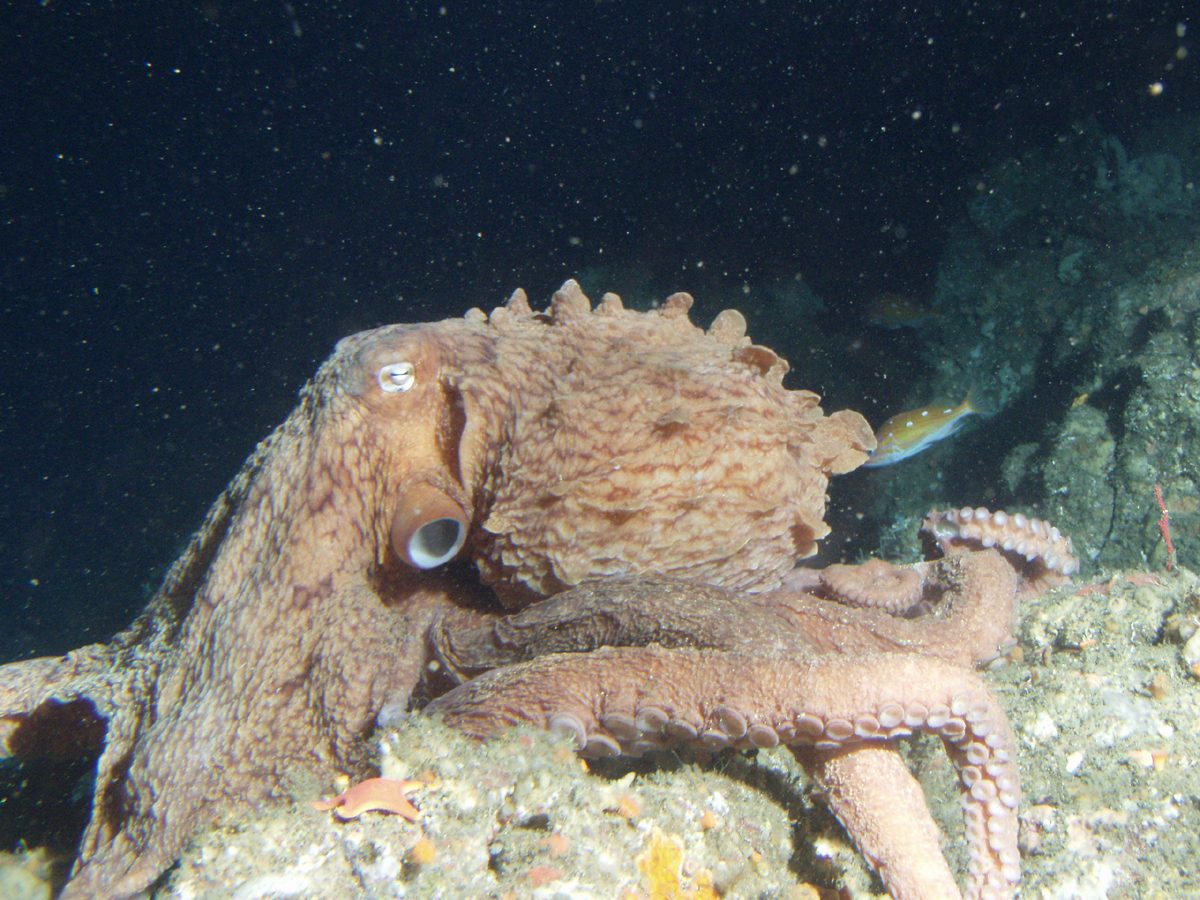

The rock blinked.
Nobody on the reef saw it happen. That was the point.
The rock was a giant Pacific octopus, holding very still in the cold green water of the North Pacific. Her skin had turned boulder gray. Her skin had turned bumpy too, rough as old stone, because an octopus changes the texture of her skin as easily as its color.
She had a good reason to be a rock.
Moments earlier, the reef had gone strangely quiet. Fish tucked themselves into cracks. The kelp swayed, and through it slid a long, sleek shadow. A harbor seal. Hungry. Very good at finding octopus.
The octopus watched it with one quiet eye. Her three hearts kept a slow, steady beat, two of them sending blood to her gills, one to everything else, all of it blue, colored by copper, made for cold seas.
She was built almost entirely of softness. In a world of shells, claws, and teeth, her one hard piece was a small beak, shaped like a parrot's, tucked away where her eight arms meet. Some hunters thought that made her easy.
The seal circled her boulder. Nosed closer. Closer.
Now.
She vanished behind a puff of ink, a soft dark cloud hanging in the water almost in the shape of an octopus, and she jetted away, squeezing water through her siphon, shooting backward through the kelp.
But jetting is hard work. An octopus's biggest heart rests while she jets, which is why she prefers to crawl, and why she keeps a plan ready instead of relying on speed.
She had made her plan on calm days, gliding over every stone of this reef, tasting as she went. An octopus tastes with her suckers, about two thousand of them, so she knew her home by touch and by flavor, stone by stone.
There. A crack in the reef wall, thin as a letterbox.
She poured herself into it like water. Arms first. Then her soft head. Then all the rest, folding and flowing, because any gap wider than her beak is a door.
The seal found gray stone, a fading cloud of ink, and a crack far too narrow for a seal to follow. It moved on.
Inside, in the dark, the octopus settled and rippled back to her favorite deep red, just for herself.
When night came, she slid out and hunted the slow, clever way, walking on her arms across the reef. Each arm did some of its own thinking, reaching into hollows, feeling and tasting, because most of an octopus's nerves live in her arms. She caught crabs and clams, carried them home, and stacked the clean, empty shells outside her den door, tidy as a garden.
The reef settled. The tide breathed in, and out.
Soft can be mighty. The finest armor in the sea is a calm and curious mind.
And somewhere in the deep green water, a rock blinked once, and kept its secret.