
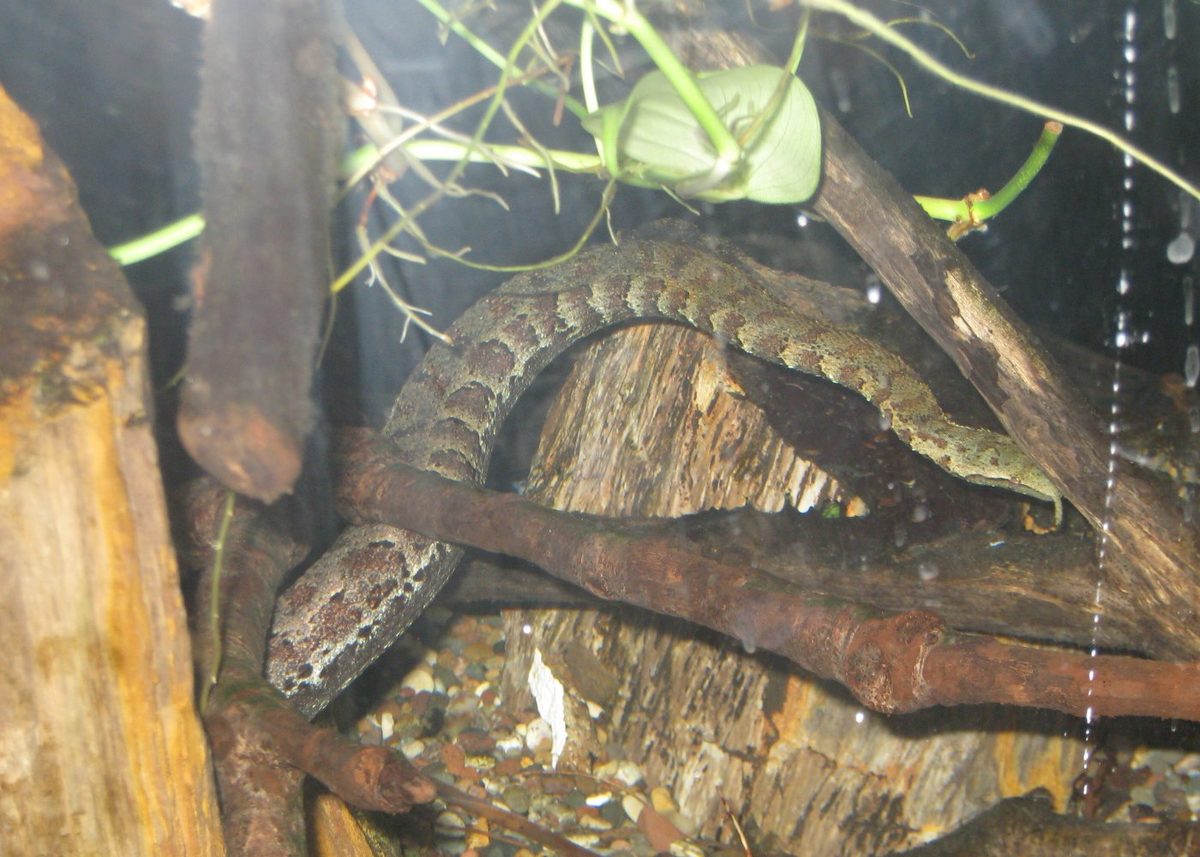

In a slow brown river in Southeast Asia, something bent itself into the shape of a J and waited for the water to forget it was there.
The tentacled snake lived almost entirely underwater, in the quiet backwaters of Thailand and Cambodia and Vietnam, and she had not surfaced for breath in a while yet. She could hold that easily. Air was not the thing on her mind.
Fish were.
Two small fleshy tentacles grew from the front of her snout, soft and strange and exactly as useful as they looked odd. They could not see. They did not need to. They felt the water instead, every tiny current, every ripple a swimming fish left behind it like a signature.
A shoal of small fish drifted closer, unhurried, unaware.
She did not move.
Her body held its J shape, patient as driftwood, and her tentacles read the water the way a hand reads braille.
One fish drifted nearer than the rest.
Now.
She twitched. Not a strike. Not yet. Just the smallest flick of muscle along her curved body, barely a ripple, aimed at the water beside the fish rather than at the fish itself.
The fish felt it and did exactly what a fish is built to do. It flinched away from the danger it sensed, snapping its body in the opposite direction, the fastest reflex evolution ever gave it.
That reflex carried the fish directly toward her mouth.
Her strike met the water where the fish was going to be, not where it had been a heartbeat before, and by the time the fish's own escape reflex had finished firing, it was already caught.
It happened again with the next fish, and the one after that.
A heron standing at the river's edge would have caught nothing this way. A heron strikes at what it sees. The tentacled snake struck at what the fish's own body promised it would do next, and a fish cannot easily outrun a trick built from its own instincts.
She rested afterward, coiled loosely near a fallen branch, fully underwater, fully at home.
She would give birth here too, when the season came, not to eggs left drying in a nest, but to live young, born ready in the water they would never really leave. Each one would arrive already curved faintly toward that same J shape, already carrying two small tentacles on its snout, already fitted for a trick it had not yet learned to use.
It would take them time to learn the water's language.
It always did.
But somewhere in that first clumsy month, a young tentacled snake would hold still by accident, and a fish would flinch the wrong way by accident, and the lesson would arrive all at once, the way the best lessons do.
She had never once chased a fish in her life.
She had only ever curved herself still, exactly where the river was about to carry one.
The old snake let the current move past her, unbothered, unseen, and somewhere downstream another small shoal was already drifting closer, entirely unaware that the river had already decided where they were headed.