
_(7109782823).jpg)
The wall of the house had a new tenant, and the house was not sure what to think of him.
The house stood in a village in South and Southeast Asia, the kind of house where the walls breathe at night, wood and tin, thin enough that not much stays inside and not much stays outside either.
He arrived quietly, in the gap behind a shutter, and nobody saw him move in.
They only heard him.
TO-KAY.
TO-KAY.
The sound rolled out across the dark rooms like something enormous clearing its throat, and the family under the tin roof sat very still the first night they heard it.
"What is that," the youngest one whispered.
Nobody answered, because nobody knew, and not knowing is the loudest kind of silence there is.
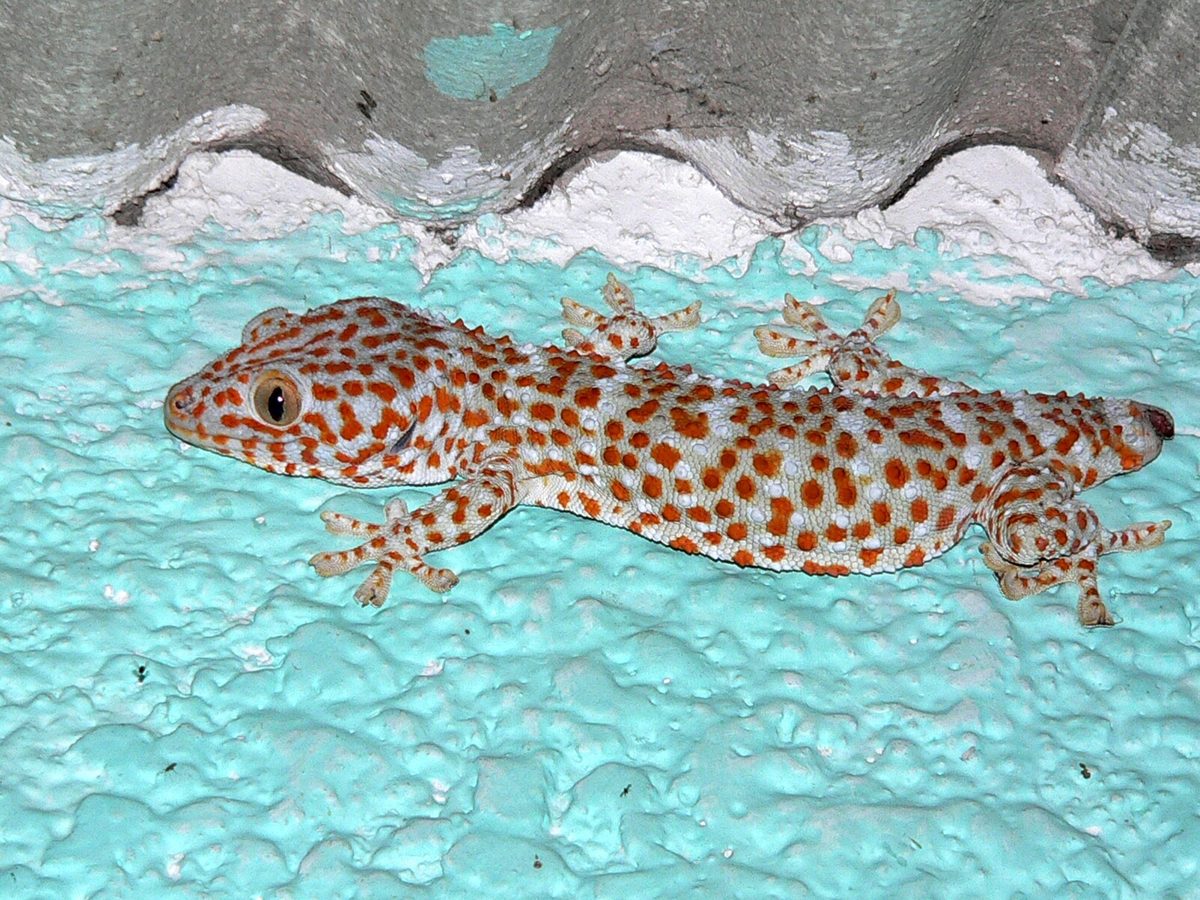
He was blue-grey, sprinkled with spots the orange of a low fire, and by day he pressed himself flat against the wall behind a calendar nobody ever turned the page on, sleeping the whole bright day away. By night, he came out and hunted, moving across the ceiling as easily as the family moved across the floor.
That was his secret, and it was not magic, though it looked like it.
Each of his toes carried millions of hair-thin threads, so fine they gripped the smoothest surface in the house, glass, paint, ceiling plaster, through nothing but touch. No glue. No claws digging in. Just contact, and the wall held him the way a hand holds another hand.
The first week, the family swept the porch and pretended not to see him.
Nobody looked up.
Then the moths came, the way moths come to any lamp left burning past dark, in restless clouds around the bulb over the door. Every night, the tokay gecko was there in the light, catching them, one after another, holding each one in a bite that did not let go until the job was finished.
By the second week, the youngest one had started counting how many moths disappeared before bedtime.
"He ate eleven," she reported, "and a beetle."
One grandmother, sweeping the same porch, began sweeping around him instead of near him. A small thing. But she had started to notice where he sat before she reached for the broom.
She swept a little wider than before.
Room enough to say she had noticed him.
Then came the night a spider heavy enough to worry the whole household came walking along the ceiling seam above the beds. The family called out. The tokay gecko was already moving, upside down, faster than anyone in the room, and his bite closed once, and held, and did not let go until the ceiling was quiet again.
Nobody swept around him after that.
They left a small dish of water near his shutter, not because he asked for it, but because a house learns, eventually, who is truly working for it.
He never changed his call. TO-KAY still rolled through the dark rooms every night, and the youngest one still whispered the first few times each season, though now she smiled when she did it.
"He's just saying his name," she told the new baby, months later, when the baby startled at the sound. "He's telling us he's home."
Outside, the night filled with insects looking for the light. And on the wall above the door, holding perfectly still, upside down, without a single drop of glue, a blue-grey gecko with orange spots waited for his name to finish echoing, and then went back to work.