.jpg)
Hold on.
In the seagrass meadow, that was the first rule of every single day.
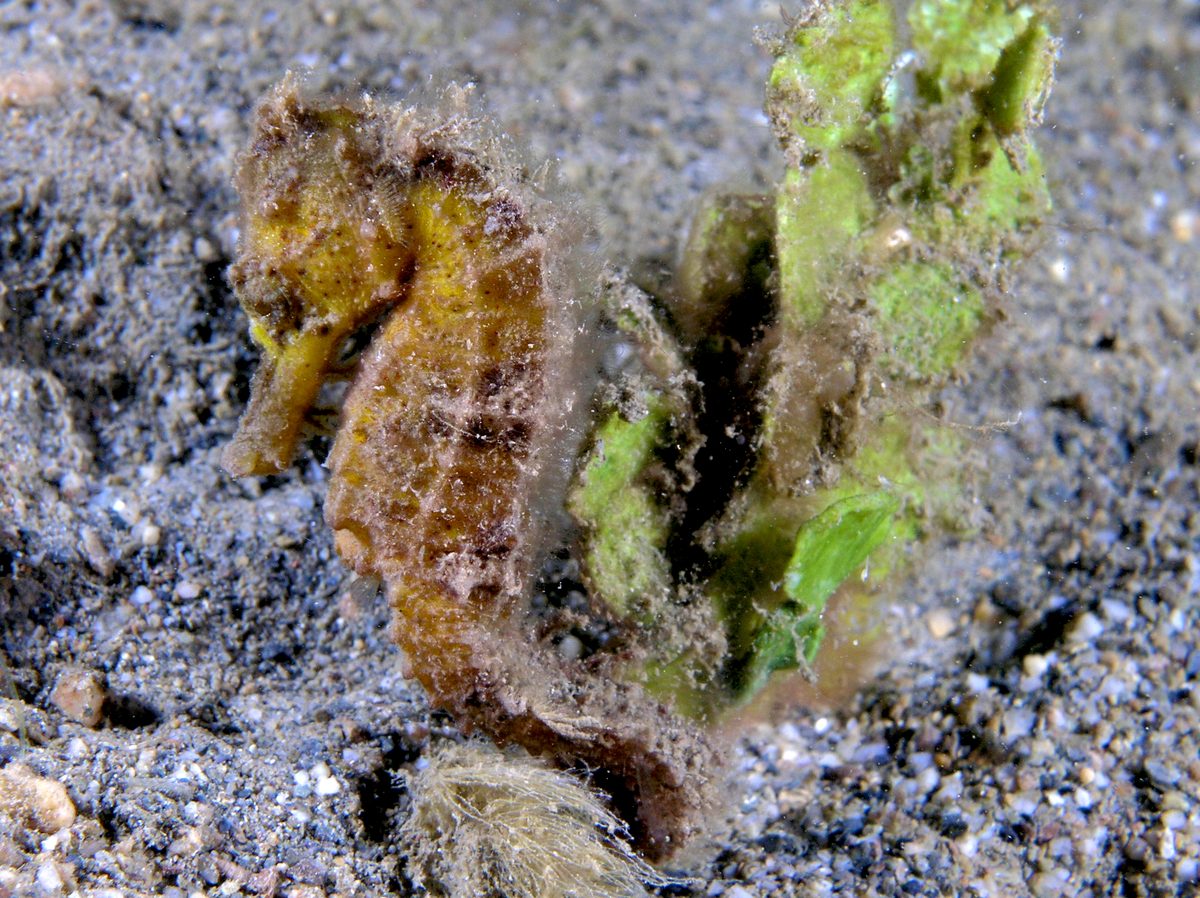
The tide pulled one way. The current combed back the other. And through it all, a small yellow seahorse kept his tail wrapped around a blade of grass and held on, standing upright in the water like a tiny chess piece.
He was a horse no taller than a pencil. He was also a fish, one of the slowest swimming fish in the whole ocean. The little fin on his back fluttered like a fan, and still he traveled slower than a drifting leaf. In the open water beyond the meadow, silver fish flashed past like arrows.
Fast is one way to live in the sea.
The meadow teaches another.
One afternoon, a shadow slid across the grass. A big hunting fish had come, and in a single blink the meadow looked empty.
Looked empty.
The seahorse had turned the exact green of the seagrass, and he held so still that he became one more blade among thousands. One of his eyes watched the shadow glide by. His other eye, all on its own, watched a tiny shrimp drifting closer. Seahorse eyes can do that, each one looking its own way, like a chameleon's.
The shrimp floated within reach. His long snout tilted, and slurp, faster than a blink, the shrimp was gone. Seahorses have no stomach to store big meals, so he eats like this nearly all day, one tiny snack at a time, without ever chasing anything. The food comes to him, because he knows how to wait.
The shadow found nothing, and moved on. The meadow slowly reappeared, seahorse by seahorse.
Then came his favorite part of the day.
Through the grass came his mate, her colors turning bright. They wrapped their tails around the same blade and turned slowly around it, a small, unhurried dance in the swaying green.
Weeks ago, at the end of a dance like this one, she had given him her eggs, tucking them into the special pouch on his belly. Ever since, he had carried them and kept them safe while the pouch grew round as a berry.
Now the pouch was full of tiny flickers.
When the time came, the father gripped his blade of grass and bent and swayed, and out of the pouch came the babies. Ten, then dozens, then hundreds, each one about the size of a grain of rice, each one a perfect little seahorse. They swirled up into the water like a drift of tiny question marks. For their first days they would ride the open currents, and then, when they were ready, each one would find a blade of grass of its very own and take hold.
The father watched them go, still anchored to his grass.
The open sea belongs to the fast. The meadow belongs to the patient.
Slow can be steady. Small can be strong. And holding on, it turns out, is its own kind of brave.