
_-_Flickr_-_2ndPeter_(2).jpg)
Something did not add up in the tall grass at the edge of the cornfield.
A red-tailed hawk folded its wings, dropped toward the ditch, and pulled up empty-taloned at the very last moment, as if it had changed its mind about a meal already caught.
It happened again a week later. A fox trotted along the fence line, nose down, and swerved wide around a fallen log without ever looking beneath it.
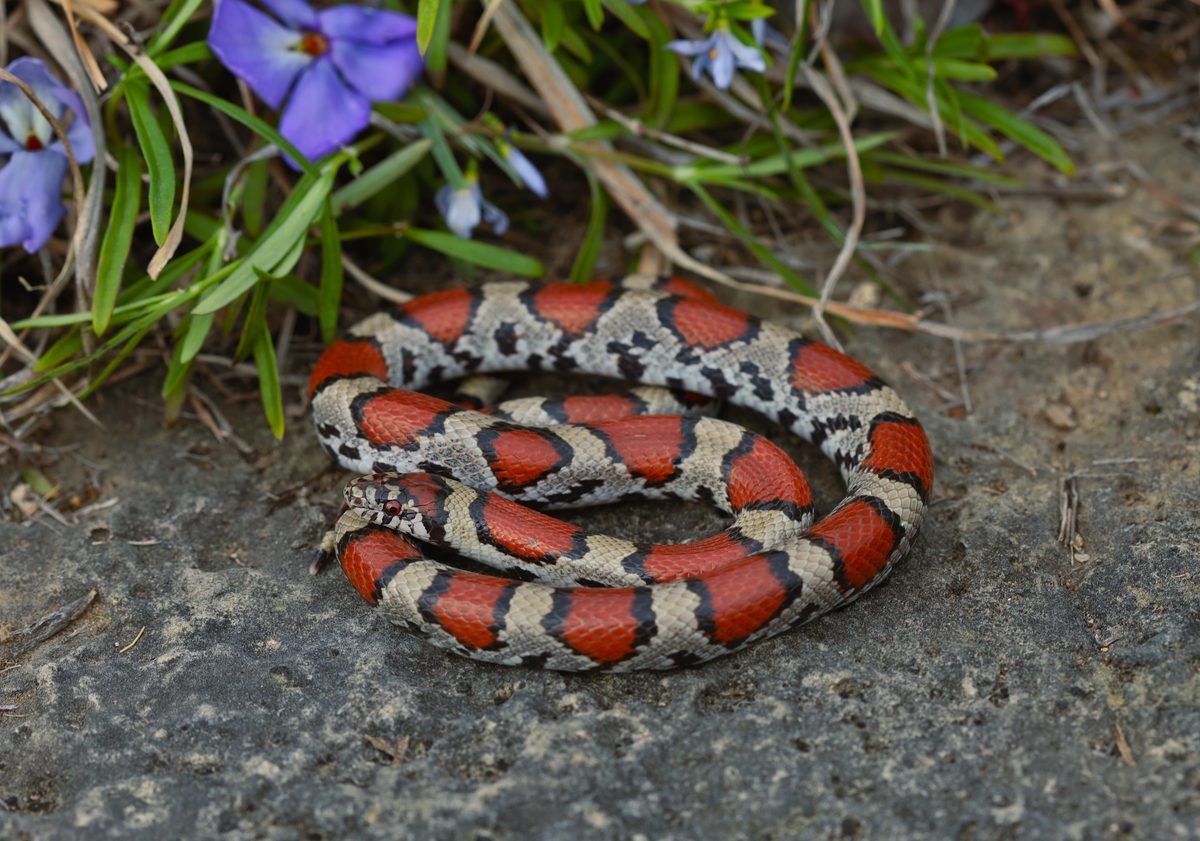
Under that log lay a young milk snake, banded in red, black, and yellow, about as long as a grown man's arm. She had done nothing. She had not lifted her head. She had not opened her mouth.
She only lay there, and the whole hunting world seemed to step around her.
She did not understand it yet.
She was a kingsnake, close cousin to some of the boldest snake-eaters in the grass, but she had never once needed her strength. Not against a fox. Not against a hawk. Something about her colors did all her fighting before a fight could start.
At night she hunted the way her whole family hunted, patient and low to the ground, following the warm smell of a mouse through the corn rows. She found lizards under flat stones. Once, carefully, she found another snake, a young copperhead with venom of its own, and she ate that one too, the way her kind always had, some old resistance in her blood keeping the poison from ever slowing her down.
None of that explained the hawk.
Then one evening she came around the same fallen log and found someone else already using it, a coral snake, banded in the very same three colors, red touching yellow down its whole bright length.
The coral snake did not move for her. It did not need to. Everything nearby already knew what those colors, in that order, could do.
She watched it a long while.
Her own bands ran the same three colors. But hers touched red to black, never red to yellow, a small difference that meant everything to her and almost nothing to anyone glancing quickly through tall grass.
The hawk had not known the difference. Neither had the fox.
That was the whole trick, and she had been wearing it her entire life without ever asking for it.
She thought about the barn two fields over, where a farmer once found her curled warm among the grain sacks and decided, wrongly, that she had come for the milk in his pails. No snake drinks milk. She had come for what the milk always drew in: mice, fat and slow among the sacks, easy to find in the dark.
He had been wrong about her twice now, in two different ways, and both mistakes had kept her fed and safe.
She slid on past the coral snake, unbothered, and let the night carry her back toward the corn.
Somewhere behind her, a barn owl caught sight of red and black and yellow moving through the stalks, and thought better of it, and flew on.
She never had to explain herself.
Some colors do the talking before anyone gets close enough to ask a question.
And in the tall grass, where one wrong guess can cost a hawk its whole dinner, nobody stops to check twice.