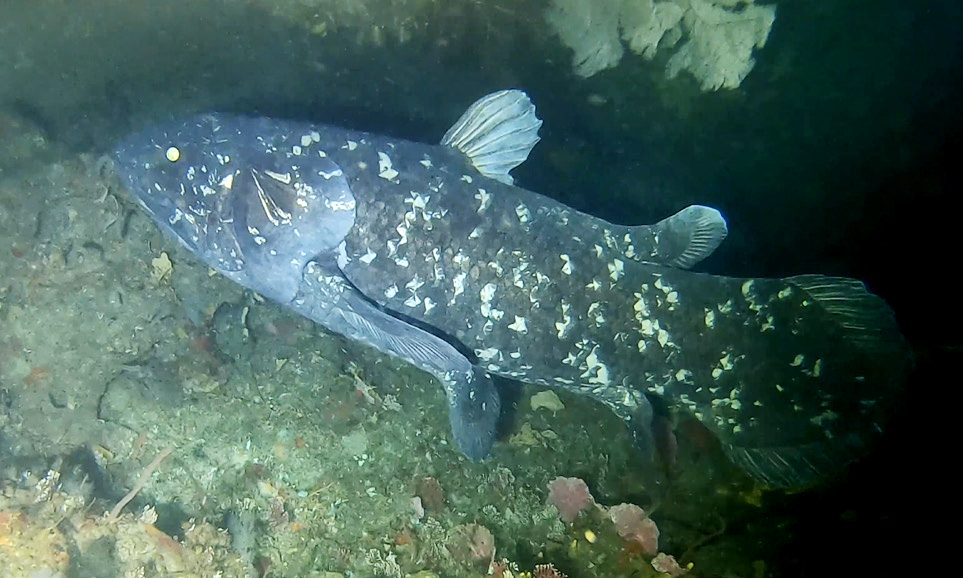

Two hundred metres beneath the waves, where sunlight is only a rumor, an old fish hung still inside a cave of black lava rock.
Her scales were midnight blue, dusted with white flecks. Every coelacanth wears its own pattern of flecks, the way you wear your own fingerprints. Hers said: I am old. I am patient. I am still here.
Around her, others of her kind rested, waiting for the dark. That is the coelacanth way. Doze in the caves by day. Drift out to hunt when night fills the water.
Beside her, a young one fidgeted.
"I am hungry," he said.
"You are always hungry," said the old fish.
"Last night the current ran strange. Every fish hid from me."
"Then tonight," she said, "I will teach you our family's oldest trick."
Night came. They slipped out along the volcanic slope, and the old fish moved her four fleshy fins in pairs, left front with right back, right front with left back, the way a walking animal moves its legs. Her family has swum this way since before the first dinosaur hatched.
"Now watch," she said.
She tipped forward, slowly, until she stood on her head, snout pointing straight down at the rock.
The young one stared. "You look ridiculous."
"I look like supper is coming," she said. "Hush, and feel."
Inside a coelacanth's snout there is a little chamber filled with jelly, and it feels the faint electric whisper that every living body gives off. In water too dark for any eye, she could feel the sea breathing around her.
A flicker. Below, to the left. A cuttlefish tucked deep in a crevice, certain it was hidden.
Her skull carries a secret hinge, so her mouth opens wider than a fish her shape should manage. One slow drift. One quick snap. Supper was settled.
The young one tried the headstand. He wobbled. He tried again. By morning, he could feel a heartbeat hiding inside stone.
"Who taught you this?" he asked as they glided home.
"My mother," said the old fish. "And the sea taught her, a very long time ago."
Here is the part the old fish never knew.
Far above her caves, in the bright dry world, people had written her family's ending. Extinct, said the books. Sixty-six million years gone, filed away with the dinosaurs.
Then, in 1938, off a river mouth in South Africa, a trawler hauled up its net, and in it lay a heavy blue fish with white flecks and fins like little legs. A young museum keeper named Marjorie leaned in close, and her heart jumped. She was looking at something the books called impossible.
The books were rewritten. Found, said the world. Alive.
The coelacanths, of course, had known where they were the whole time.
Being forgotten is not the same as being gone. Some families simply keep their light down in the deep.
And two hundred metres below the waves, in the black lava caves, the old ones hang quietly in the dark, patient as mountains. Still here. Still here. Still here.