
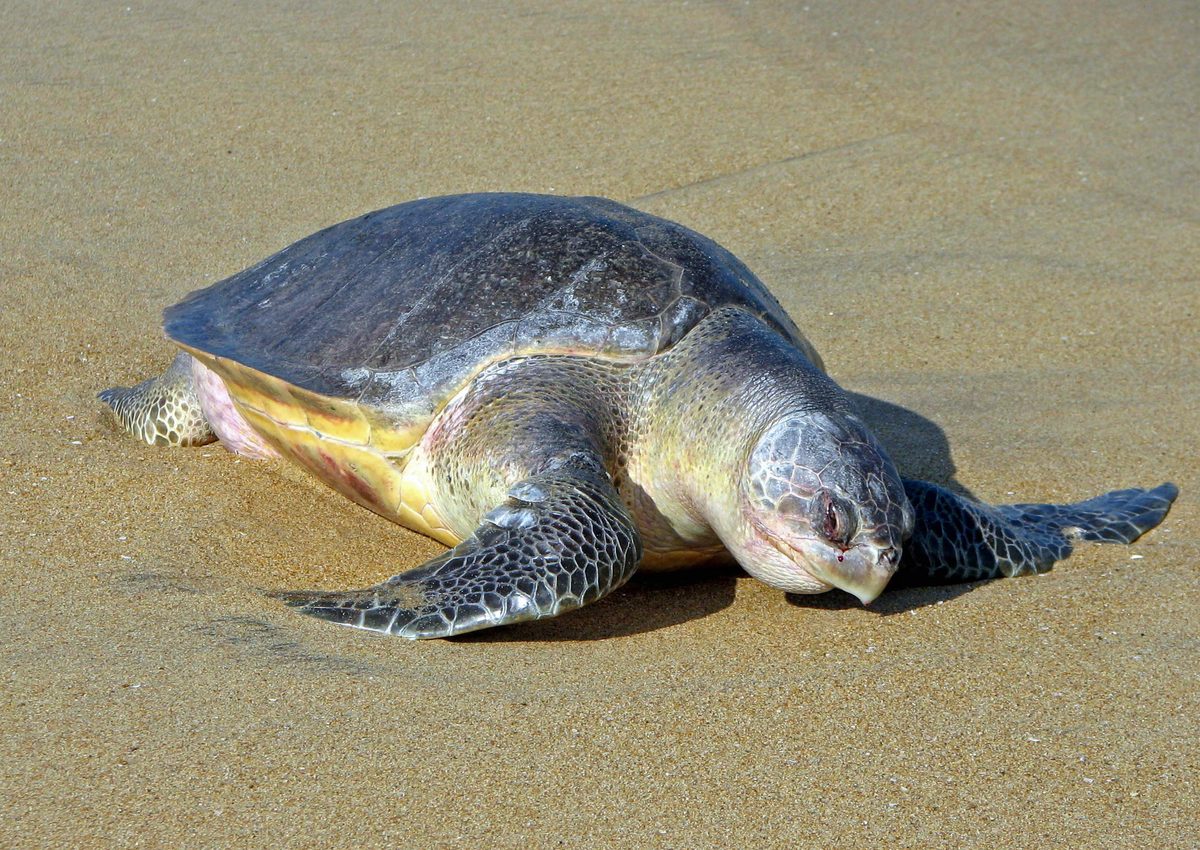

Something old was pulling her home, and she had stopped trying to explain it to herself.
She was an olive ridley, her shell about sixty centimeters long, smaller than most of the other sea turtles she had ever passed in open water. Of every sea turtle alive, her kind is the most numerous of all, though most nights you would never guess it, since most nights she swam alone.
She had spent nearly all her years in warm water, going wherever the current suggested and the fish were plentiful.
Then, one week, the water changed.
Not the temperature. Not the current. Something quieter than that, and she was not the only one who felt it.
She began to see others of her kind, more than she had ever seen at once, all moving the same direction she was.
Two.
Then a dozen.
Then more than she could count, gliding beside her through the blue like a slow green wind.
None of them had agreed to meet. None of them had a plan they could have spoken aloud. They only carried a feeling, kept since they were hatchlings themselves, of a particular stretch of sand where the current runs a certain way and the shore meets the water at a certain angle. Most of them had hatched somewhere within reach of that very coastline, years before, and now something in each of them was steering her back toward that same region, not to the exact grain of sand, but close enough that it hardly mattered.
She reached the shallows on a warm, dark night, and found she was not arriving so much as joining.
This was a coast much like Ostional in Costa Rica, or the shore of Odisha in India, one of the very few beaches in the world built for a night like this.
The water ahead of her churned with shells.
Hundreds of them.
Then more than hundreds.
By the time she found a place on the sand to dig, there were turtles on every side of her, as far as she could see in the low light, each one working her own patch of beach as though the crowd around her were the most ordinary thing in the world.
It was not ordinary. It happens on only a few beaches, a few times a year, never on most nights. But she did not know that, and would not have cared. She only knew there was room for her, and sand soft enough to dig, and about a hundred eggs to lay before the sky began to lighten.
She dug with her back flippers, steady and unhurried, laid what she carried, and covered it over so carefully that by morning the nest looked like nothing at all. Just sand, like all the other sand.
Then she turned back to the sea, one shape among thousands making the same short, tired walk, and let the water take her.
Weeks later, on that same crowded stretch of beach, the sand began to move on its own.
Small shapes, no bigger than the palm of a hand, broke the surface together and ran, all of them, toward the one direction that mattered, guided by the paler light over open water. They ran at night, when the sand was cooler and the birds were fewer, dozens of small dark shells crossing the beach at once, and the sea opened up in front of each of them like something remembered rather than new.
She was already far out in the blue by then and never saw them go.
But some of them, years from now, grown broad and strong, will feel that same quiet pull return, and follow it back to a coastline very near this one, and find it crowded with mothers, and know, without ever being told, exactly why.