.jpg)
Something had gone wrong, and she was upside down.
A wave had rolled her over on the sand, and now the sky was under her instead of over her, and ten eyes that had never all looked at the same thing before were suddenly full of nothing but empty blue.
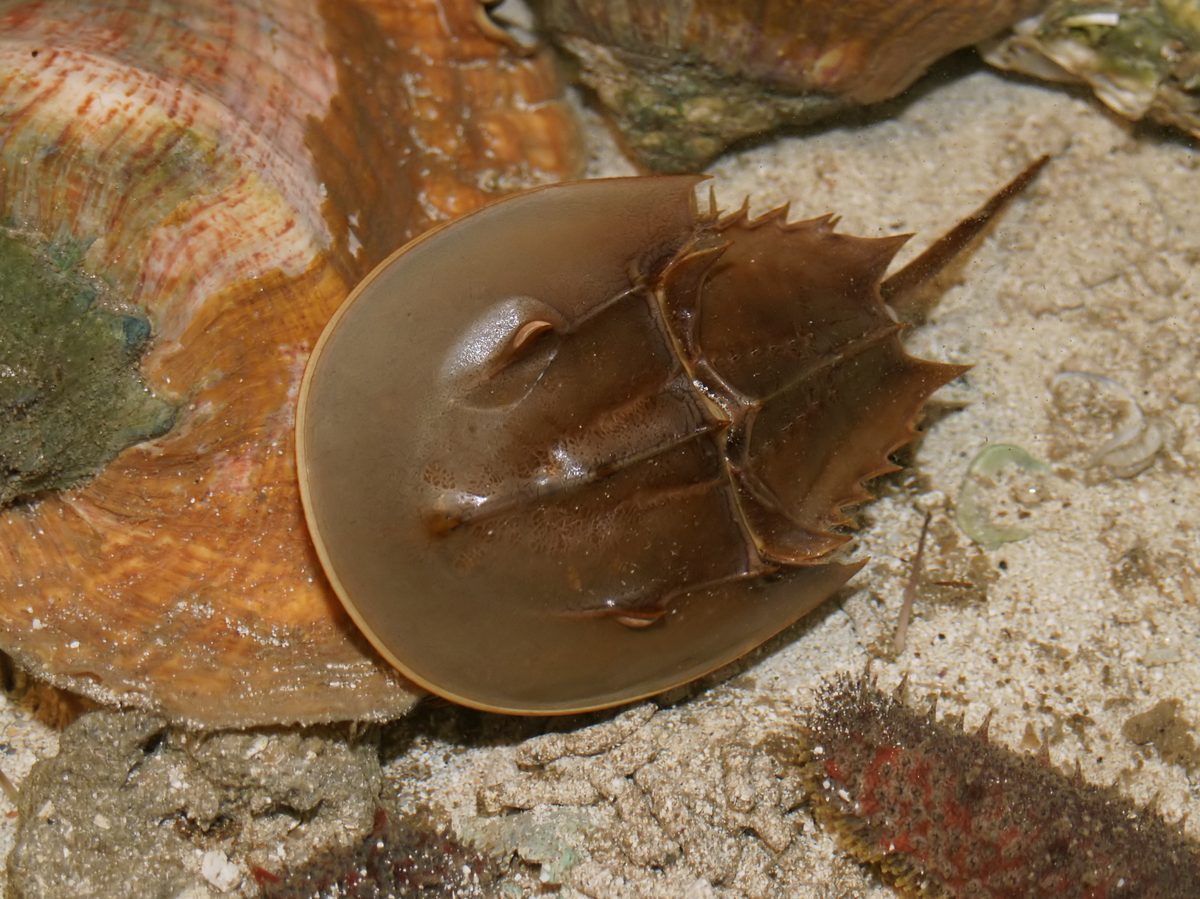
She was an Atlantic horseshoe crab, and despite her name she was no crab at all. Her closest relatives were spiders and scorpions, and like them she wore her whole soft self under one hard, curved shell shaped like a horseshoe.
Legs worked at the air. Nothing to push against there.
A gull landed nearby and considered her.
She was not without a tool for this.
Behind her shell trailed a long, stiff spike of a tail, sharp enough to look dangerous and yet not built for danger at all. She planted its tip in the sand, arched her whole body, and pushed.
Once.
Twice.
On the third push, the world flipped back the right way round, and the gull, unimpressed, wandered off to try its luck elsewhere.
Her kind had been solving exactly this problem, in exactly this way, for more than 400 million years. Longer than there had been dinosaurs to watch them do it.
She herself was only a few decades into that long, unbroken line, though a few decades had already meant moulting out of shell after shell, each one a little roomier than the last, each old shell left behind on the sand like a coat she had simply stepped out of and outgrown.
One spring, on a stretch of shore far from any lagoon, careful hands lifted her gently from a boat and set her on a soft, wet cloth.
A single small sample of her blood was drawn. It ran out blue.
Soon after, she was back in the shallows, none the worse, carrying on toward the same errand she kept every spring of her adult life: the full moon, and the highest tide it pulled behind it.
That tide came a few nights later, higher than any other tide of the month, and she rode it all the way up the beach, past the last dry line of seaweed, further than the sea usually reached at all.
There, in the damp sand, she laid thousands of small green eggs.
Other horseshoe crabs were doing the same, all along the shore, all on the same tide, as if the whole moon had sent out one invitation and everyone had understood it.
Above the beach, red knots and other shorebirds who had flown a very long way arrived to feed on some of what she had buried. There were more eggs than any flock of hungry travellers could ever finish, and plenty left quietly under the sand to hatch anyway.
By morning the tide had pulled back, and so had she, sliding into the shallows on legs that had, once again, found the right side of the world to be under her.
Ten eyes, and not one of them needed to see very far.
That night the moon pulled the tide, and the tide pulled her, all the way home, the same slow way it always had, since long before anyone else was here to notice.