
Somewhere in the open ocean, no bigger than a pinhead, something new was drifting.
It had no name yet. It barely had a shape.
It was a larva, round and spined like a tiny burr, tumbling wherever the current carried it, and if you had scooped up a whole ocean's worth of drifting life in your hand, you might never have noticed the one that would grow up to be the heaviest bony fish in the sea.
Nobody looked twice at her.
Why would they. The open water held a thousand things her size and smaller, and she was, for now, just one more speck among them.
She grew anyway.
A little rounder every week, a little heavier, until the spines that once studded her whole body smoothed away, and what was left underneath looked less like a burr and more like a fin with a fish attached.
She ate what drifted past her, mostly jellyfish and other soft, drifting animals, never in short supply, and she found she did not need to chase anything. The ocean brought her dinner if she only stayed patient and kept her mouth in the current.
Watch.
Wait.
Swallow.
By the time she had grown to the size of a dinner plate, the smaller fish around her had started doing something new. They drifted close, picked at her skin, and moved on. She had never asked for company. It simply began arriving.
She kept growing.
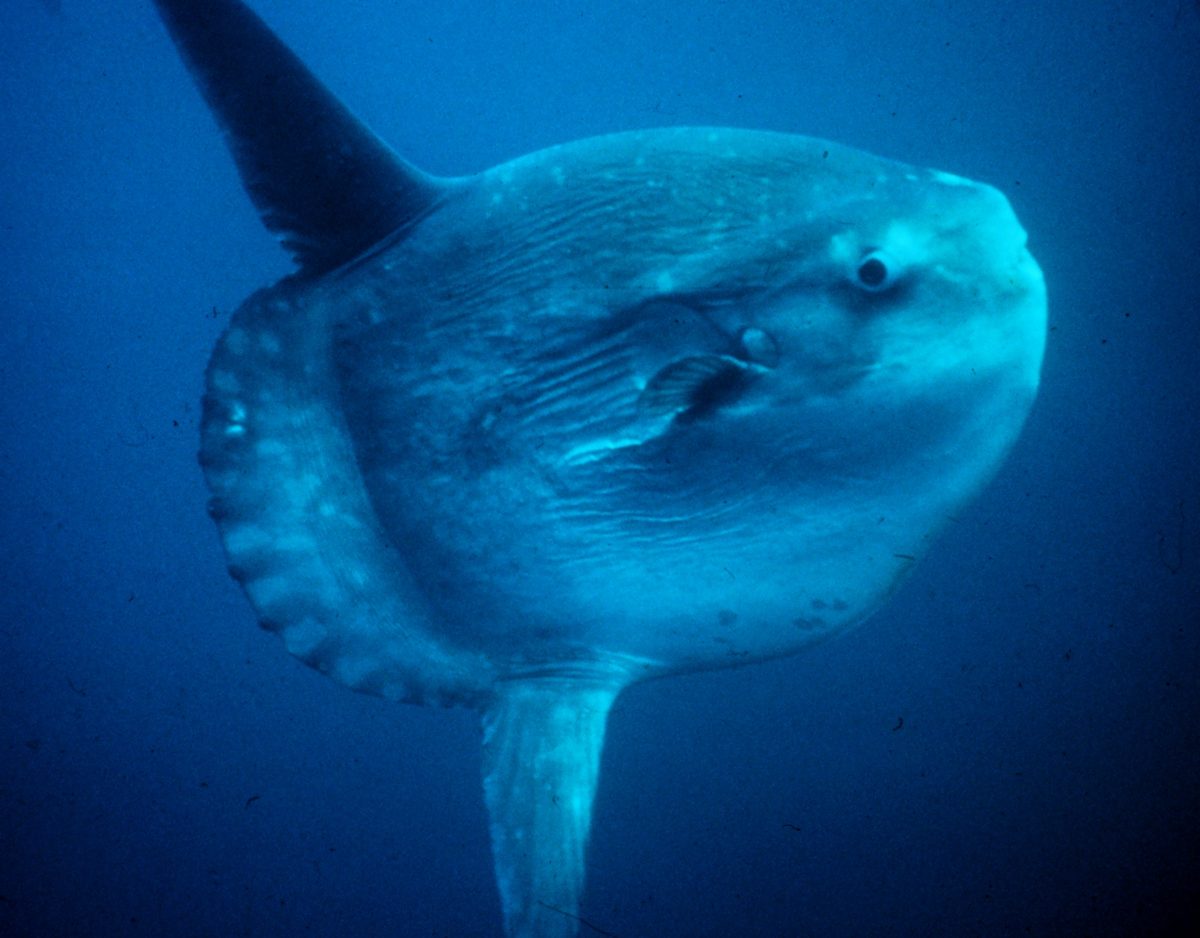
Her body flattened wide and tall, taller than it was long, until she looked less like an ordinary fish and more like an enormous swimming head, fringed top and bottom with two great fins and no real tail at all. She swam the way no other fish quite does, flapping those fins like a bird flaps wings, one slow beat carrying her further than her old shape ever could have.
Deep water was cold, and jellyfish drifted deep, so down she went, again and again, chasing her meals into the dark and the cold.
Then, every time, she rose.
Near the surface the sun warmed the water, and she turned onto her side and lay flat against it, letting the whole width of her, wider now than a grown person is tall, soak in the light.
That was when the visitors came.
Seabirds landed on her the way they might land on a floating log, and picked parasites from her skin. Small fish rose from below and did the same, cleaning the places she could never reach herself, and she lay still and let them work, patient in the sun the way she had always been patient, since the days she was too small for anyone to see.
She had started as a speck adrift in a whole ocean, one larva among more eggs than any other creature with a backbone is known to carry, hundreds of millions of sisters and brothers scattered into the current at once.
Almost none of them would grow at all.
She had.
Now she rested on the surface, warm and enormous and entirely at peace, the heaviest of her kind in the whole wide sea, still catching the sun the way she always had, back when she was smaller than anyone could see.