
About two hundred and fifty years ago, deep under a hill in the Netherlands, lamplight fell on something impossible.
Workers were cutting blocks of soft, pale limestone in a dark tunnel when a wall opened onto teeth. Rows of sharp teeth. A huge jaw, turned to stone, resting in the rock as if it had been waiting.
The workers raised their lamps and stared.
They stood inside a hill, in the middle of farmland, beside a quiet river called the Meuse. The sea lay far away over the horizon.
So a mystery ran from village to village: how does a sea monster get inside a hill?
The answer is better than any legend, and every word of it is true.
About sixty six million years ago, that hill was the floor of a warm, shallow sea that covered much of Europe. Ammonites drifted through it in spiral shells. Sea turtles rowed over the white seabed. Sharks flicked through the blue. And through the middle of it all moved the giant of that sea.
Mosasaurus.
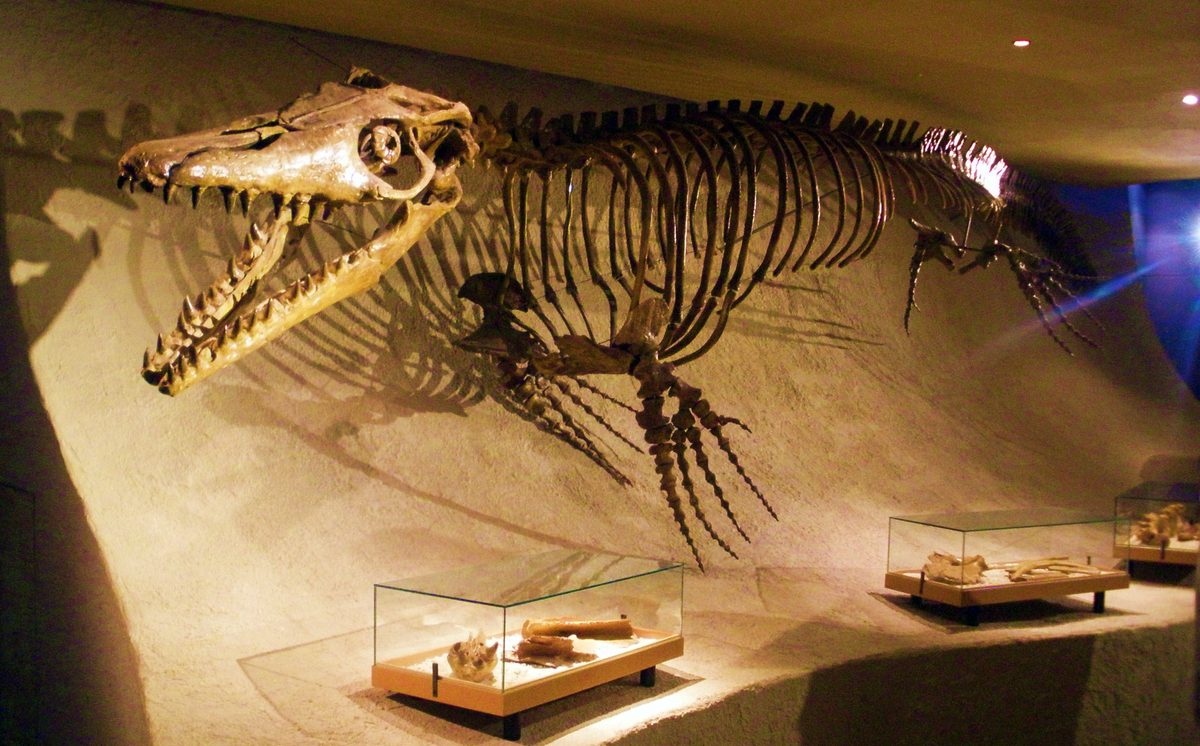
She was a lizard, cousin to today's lizards and snakes, grown as long as a bus, with four paddle-shaped flippers and a long, powerful tail that drove her through the water. She hunted fish and sea turtles, and when something slippery wriggled in her jaws, she kept her grip, because a second set of teeth curved backward along the roof of her mouth. In her mouth there was one direction. Down.
And every little while, this giant did something gentle. She rose to the surface, took a breath of warm Cretaceous air, and slipped under again, just as whales do today.
She lived long, and she ruled her sea. When her life ended, she settled to the seabed, and the shells of tiny sea creatures drifted down and covered her, softly, year after year, until the seabed pressed itself into pale stone.
Then the sea left. The land rose. The stone became a hill beside a river.
And she waited, sixty six million years, for the sound of digging.
When her skull came out of the tunnel, wise people argued about it for years. A crocodile, said some. A strange whale, said others. At last scientists understood: this was a giant lizard whose whole tribe had vanished from the Earth. That idea changed science forever. Her stone skull helped teach the world that animals can go extinct, that our planet is far older than anyone had dreamed, and that every species alive today is a treasure.
They named her Mosasaurus, the lizard of the Meuse, after the little river that still flows past her hill. Her skull travelled to Paris, where, the story goes, the soldiers who carried it away were rewarded with six hundred bottles of wine. It rests in a museum to this day, and children lean close to the glass to count her teeth.
She was the queen of a vanished sea.
Now she is a teacher, and her lesson is a gentle one: notice every living treasure while it is here.
Sleep well, old queen. The whole world knows your name.