
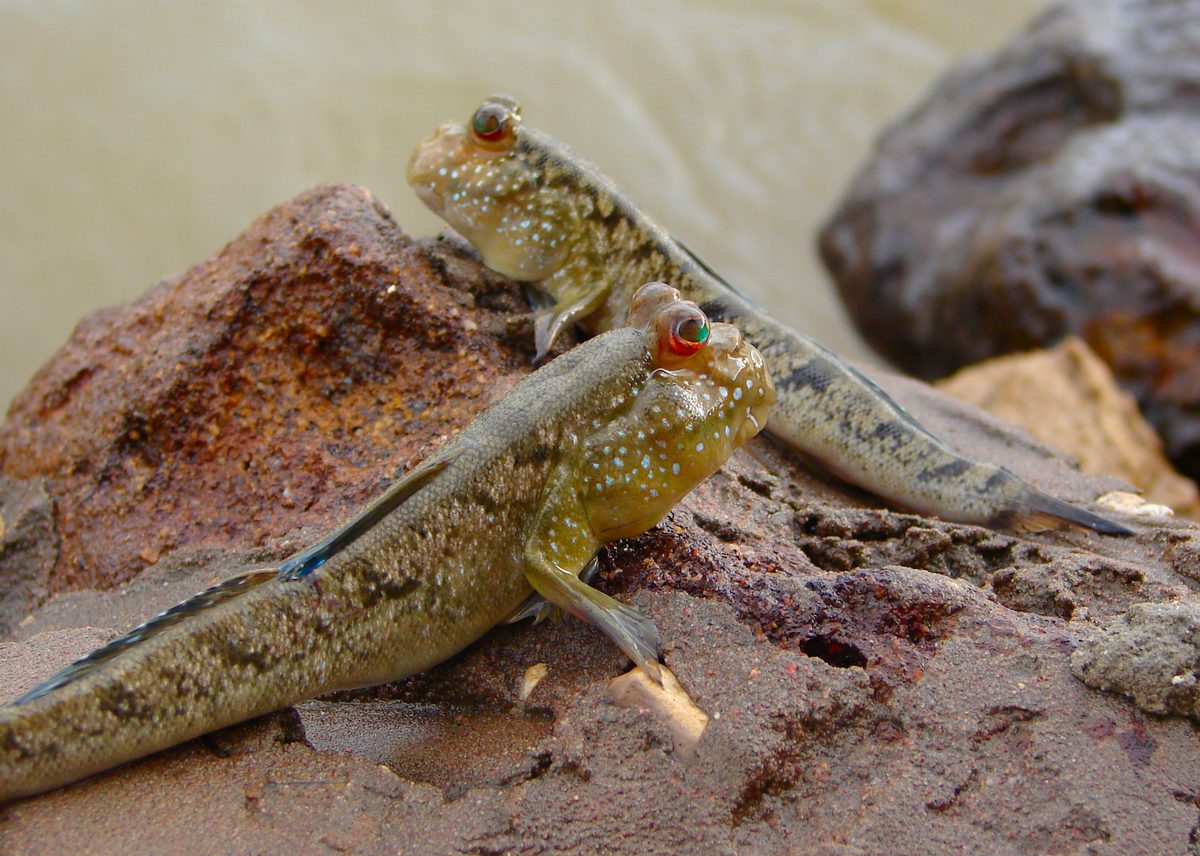

Something was wrong with the fish on the mud.
She was out of the water.
Not stranded. Not gasping. She had chosen to be there, an Atlantic mudskipper about twenty centimetres long, propped on her front fins like elbows, staring out across the flat mangrove mud of the West African coast.
Other fish waited for the tide to bring the sea to them.
She went the other way.
Her fins worked like small oars, throwing her forward in short skipping hops, and where the mud dried and cracked in the sun, she skipped faster still.
Nearby, one small crab paused mid step, watching a fish walk past it on land, and did not know what to make of that.
She breathed through her skin, and through the damp lining of her mouth, the way frogs manage on land. But skin needs to stay wet to work at all, so before she had crossed halfway to the mangroves, she rolled her eyes back into two pools of water she carried in their own sockets, gave them a slow blink, and kept going.
A mouthful of water rode along inside her too, kept back for her gills, the way a diver carries a tank.
At the roots she climbed.
Up the slick curve of a mangrove trunk, gripping with the same fins that had carried her across the mud, higher than any fish had any business being.
From up there she could see her whole territory. A stretch of mud with her name on it, though nobody else could read that name but her.
A second mudskipper skipped in from the flats, testing the edge of it.
She dropped from the root, fast, and squared herself against him, mouth open, fins braced.
He hesitated.
Then he turned back toward open mud, and did not try that patch again.
Her burrow waited below, a tunnel she had dug herself into the wet mud, with a bend in it that held a bubble of air at the top, like a room with its own ceiling of breath. Eggs would go there one day, safe below the surface, breathing air she had carried down and left behind for them.
For now, the burrow was only hers.
She patrolled the mud at low tide, snapping up insects that landed on the wet flats, small crabs that were slower than they thought they were, worms that surfaced and regretted it.
And in the evenings, males from up and down the shoreline did what males of her kind do.
They leapt.
Straight up, fins spread, bodies arcing over the mud and landing with a small wet slap, again and again, each leap a small announcement thrown into the air for anyone watching.
She watched.
Some leaps were higher than others. She noted which ones.
The sea came back twice a day, the way it always had, sliding in over the flats and covering the mud she had claimed on her own two fins.
She did not wait for it, the way the rest of the reef waited.
She met it halfway, skin already dry from her walk, gills already rinsed from the water she had carried herself.
A fish, on land, minding her own patch of mud, answering to nobody's schedule but the tide's, and even that only when it suited her.
The mangroves keep their roots in two worlds at once.
So does she.