,_Nosy_Komba,_Madagascar,_2025-09-12,_DD_30.jpg)
Something was wrong with the flowers.
Not damaged. Just waiting. Open, bright, and full of nectar, with nobody coming to visit them.
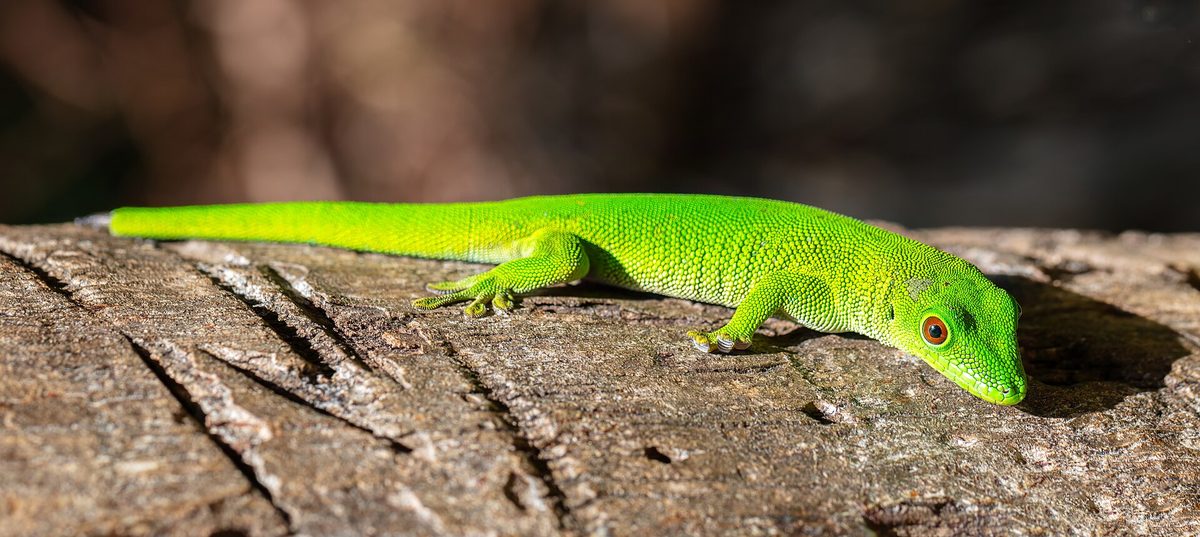
In northern Madagascar, the morning sun found a gecko already awake on a broad green leaf, which was strange all by itself, because most lizards prefer the dark.
She was vivid green, the color of the leaf itself, with small red markings scattered like paint flicked from a brush, and she measured about 25 centimetres, nose to tail, long for a gecko, with some of her kind growing even longer.
She had no eyelids to blink the night away. Instead she used her tongue, long and quick, and licked her own eyes clean, and the world came into focus.
Below her, a cluster of pale flowers had opened in the heat, and their scent drifted up through the leaves, sweet and patient.
She went down headfirst, toe pads gripping the bark the way they gripped glass, leaves, anything at all, and reached the first flower just as it finished opening.
She drank.
Nectar first, sweet on her tongue. Then she pressed her face deeper, and pollen, fine and gold, dusted itself across her snout the way flour dusts a baker's hands.
She did not plan what happened next. She simply climbed on, hungry, toward the next bright flower a little further down the branch, and pressed her dusted snout into that one too.
Some of the gold stayed behind.
She spent the whole bright morning that way, moving flower to flower, drinking what she needed, eating a few soft insects along the way and a little fallen fruit, never once thinking of herself as anybody's gardener.
A male gecko, brighter still, watched her cross into his patch of bark and puffed himself up until she moved along, because a day gecko's territory is not shared lightly, not even with someone doing good work.
She did not mind. There were flowers enough.
By the time the sun dropped low, her belly was full and her snout was licked clean again, and she had visited more flowers than she could have counted, had she ever thought to count them.
Weeks later, in the same patch of forest, small green pods began to swell where those flowers had been, heavy with seed.
Nobody had seen a bee in that stretch of canopy all season. Nobody had seen a bird linger long enough to matter.
But something had crossed those flowers, unhurried, dusted gold, again and again, until the plant no longer needed to wonder where its seeds would come from.
Later, she laid two eggs of her own, glued firmly to the underside of a strip of bark where nothing could shake them loose, and went back to her flowers, certain the forest would do the rest.
It always had, ever since the flowers first learned to wait for a lizard, wide awake in the daylight, wearing pollen like gold dust on her face.