
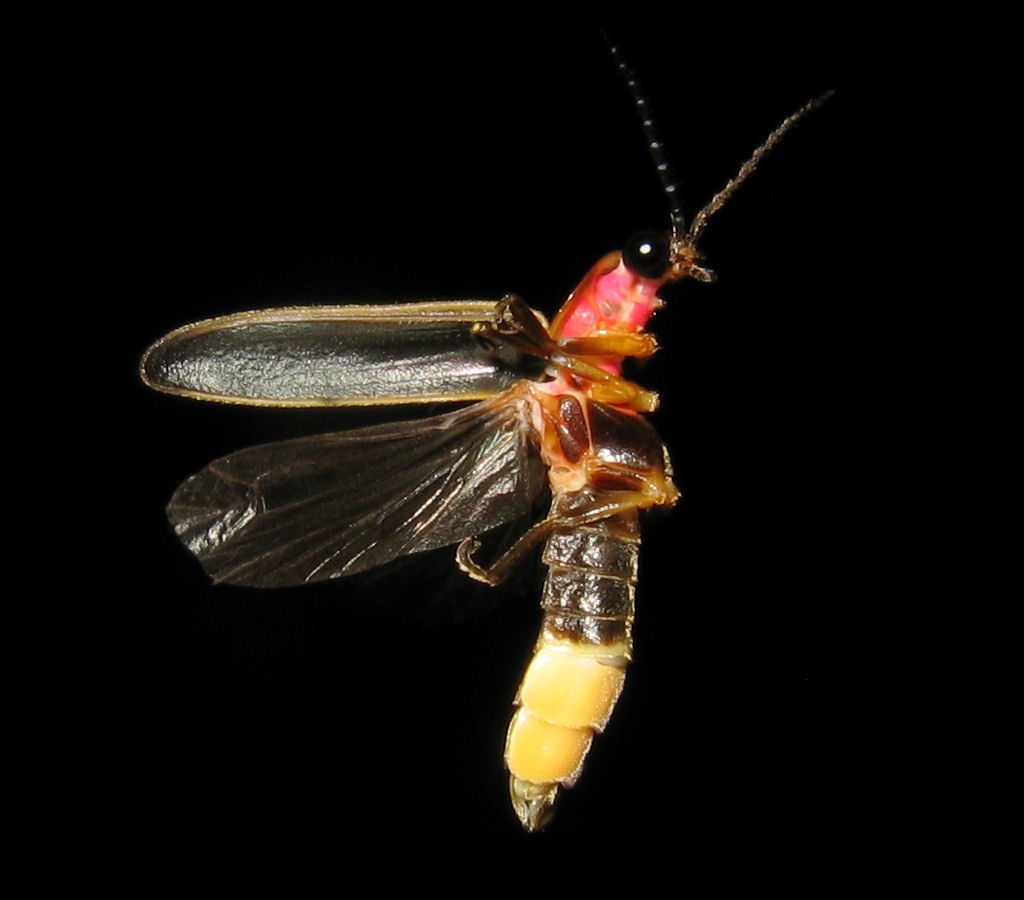

Something did not add up, about the small beetle everyone called a firefly.
He had no fly's wings. He had a beetle's hard wing cases, curved over his back like a little shield, and underneath, folded neat, a second pair of wings that did the actual flying.
The name was wrong. The animal wearing it did not seem to mind.
He began his life in the soil, in the dark, months before he ever grew wings at all. As a larva he already carried a small light in his tail end, and he used it to hunt, moving low and slow between roots and leaf litter, tracking snails and earthworms across the eastern woods and lawns of North America.
Down there, in the dirt, almost nobody saw his glow.
He grew through the seasons the way his kind must, hidden, patient, hunting by a light that cost him almost nothing.
Inside his body, a chemical called luciferin was meeting oxygen and a helper enzyme, and something in that meeting was almost too tidy: nearly every scrap of energy came out as light. Almost none came out as heat.
He could hold his own glow and never feel it burn.
Then, one summer, he changed for the last time. Wing cases hardened over true wings. Legs steadied. He left the soil behind and rose, for the first time, into open air.
Adult life did not give him long. A few weeks, and that was all.
So on the first warm evening, as the sky dimmed to the color of a bruise healing, he lifted off the grass with hundreds of other males of his kind, and began the only work left to do.
He flew in a shallow curve, up and to the side, tracing a shape like the letter J against the dark, and let his light answer for him.
Down in the grass, unseen, someone was watching.
A female of his exact kind waited low among the blades, reading each flash that passed overhead, most of them not quite right, the timing a beat too fast or too slow, the shape a little off.
She answered only one.
Her single, perfectly timed flash rose from the grass, right on the beat, right on the note.
He turned toward it, high above the grass.
Neither of them made a sound the whole time. Every word of that whole conversation was written in cold light, spoken and answered without a single degree of heat, one flash meeting another exactly where they were meant to meet.
Other lights blinked around them, dozens of other conversations happening at once across the same field, each pair somehow finding its own rhythm inside all that flashing dark.
By the end of summer, both of them will be gone. It only takes a few weeks.
But before that, in the soil under the grass where nobody bothers to look, small new lights are already beginning to glow, quietly waiting for their own turn at the sky, burning bright the whole time, and never once running hot.