
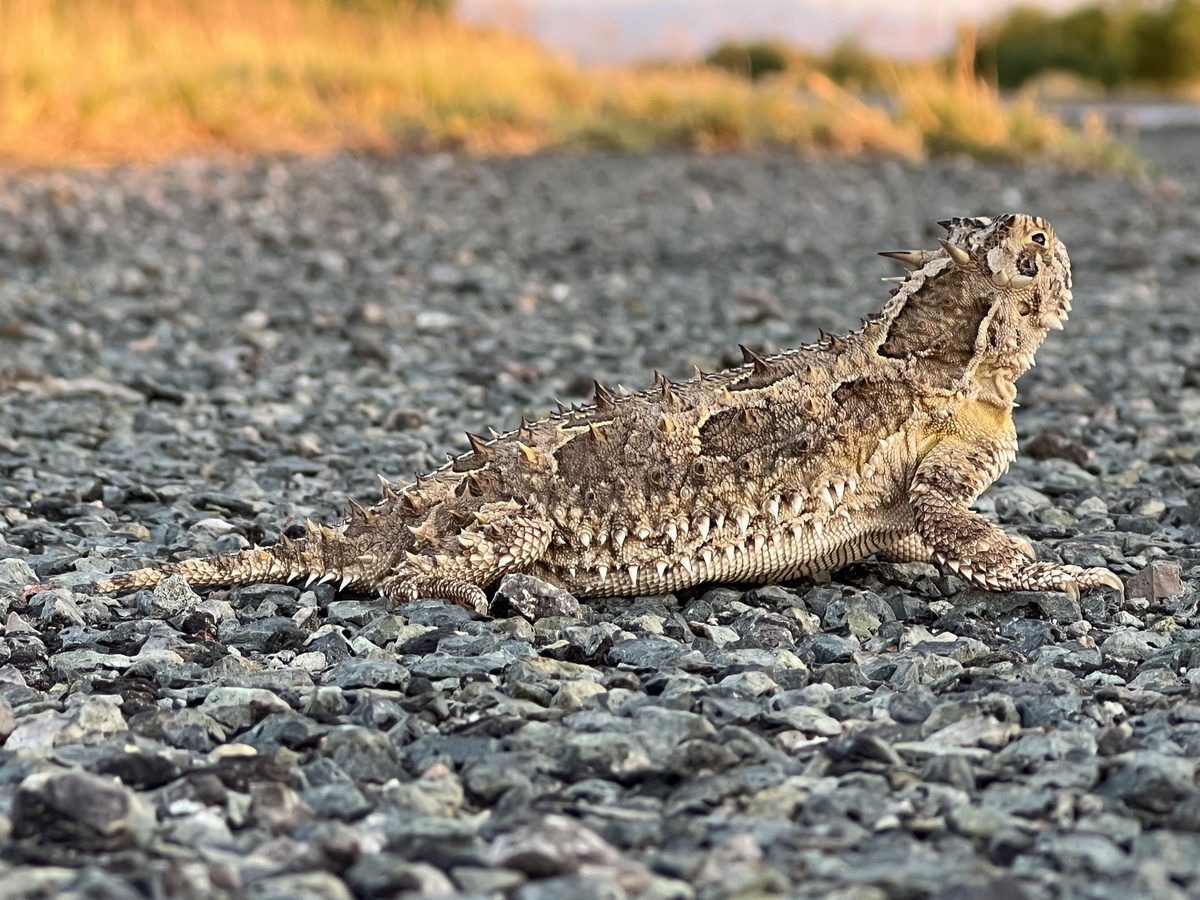

Something felt off along the sandy flats of south Texas.
A flat gray stone lay near a clump of dry grass. It had horns. It had eyes.
A Texas horned lizard is built low and wide, more crown than lizard, ringed with spines the color of dust and old gravel. She had chosen this patch of ground for a reason, and the reason walked past her twice that morning without noticing her at all.
A young fox.
Hungry. Certain that nothing interesting lived on a bare stretch of caliche and mesquite shadow.
He was wrong about that, in ways he had not discovered yet.
She held still.
Holding still was nearly her whole job, most afternoons. Near her front feet ran a thin trail of harvester ants, moving between their mound and a patch of dead grass, and she knew exactly where that trail bent. One ant. Then another. She could eat a hundred or more in a single afternoon, and she never had to chase a single one.
Sun on her back. Sand under her belly. Horns catching the light so they looked like just another handful of gravel.
The fox came back at dusk.
Closer this time, nose down, following some other scent, and his paw landed almost on the ant trail she was working through, one patient bite at a time.
He froze.
He had felt her more than seen her. A small shifting shape where the ground should have stayed still.
She did what a cornered horned lizard does. She took a breath and swelled herself up, round body puffing wider, spines standing sharper, until she looked like far too much trouble to swallow.
The fox tilted his head.
He had never eaten a spiky stone before, and something about her made him want to try anyway.
He lunged.
And from the corners of her eyes, she answered him. A thin dark jet, faster than he could flinch from, farther than his own body was long, and it caught him square across the muzzle.
He reared back, shaking his head, pawing at his own face.
It tasted foul. Not sharp like a sting. Just wrong, the way spoiled water is wrong, the kind of wrong a dog's tongue does not forget.
He sneezed. He backed away, low and unhappy, and looked at her the way you look at something you have just decided to leave alone for good.
Then he trotted off toward the mesquite and did not look back.
She let her body settle down to its ordinary size, and by the time the first stars came out over the flats, she was already digging, working herself down into the loosened sand until only the tips of her horns showed above the surface. Safe. Cool. Still.
Somewhere past the ant trail, a fox was still shaking his head.
She, meanwhile, had already gone quiet again. Gray as stone. Patient as ever.
Come the warm months she would bury her own eggs in sand this soft, and every hatchling would carry the same crown of spines, the same borrowed color of dust, and the same small trick held ready behind the eyes, just in case a hungry nose ever forgets to be careful twice.
A stone does not need to win a fight.
It only needs to make a hungry mouth change its mind, and remember why, every time it smells blood again.