
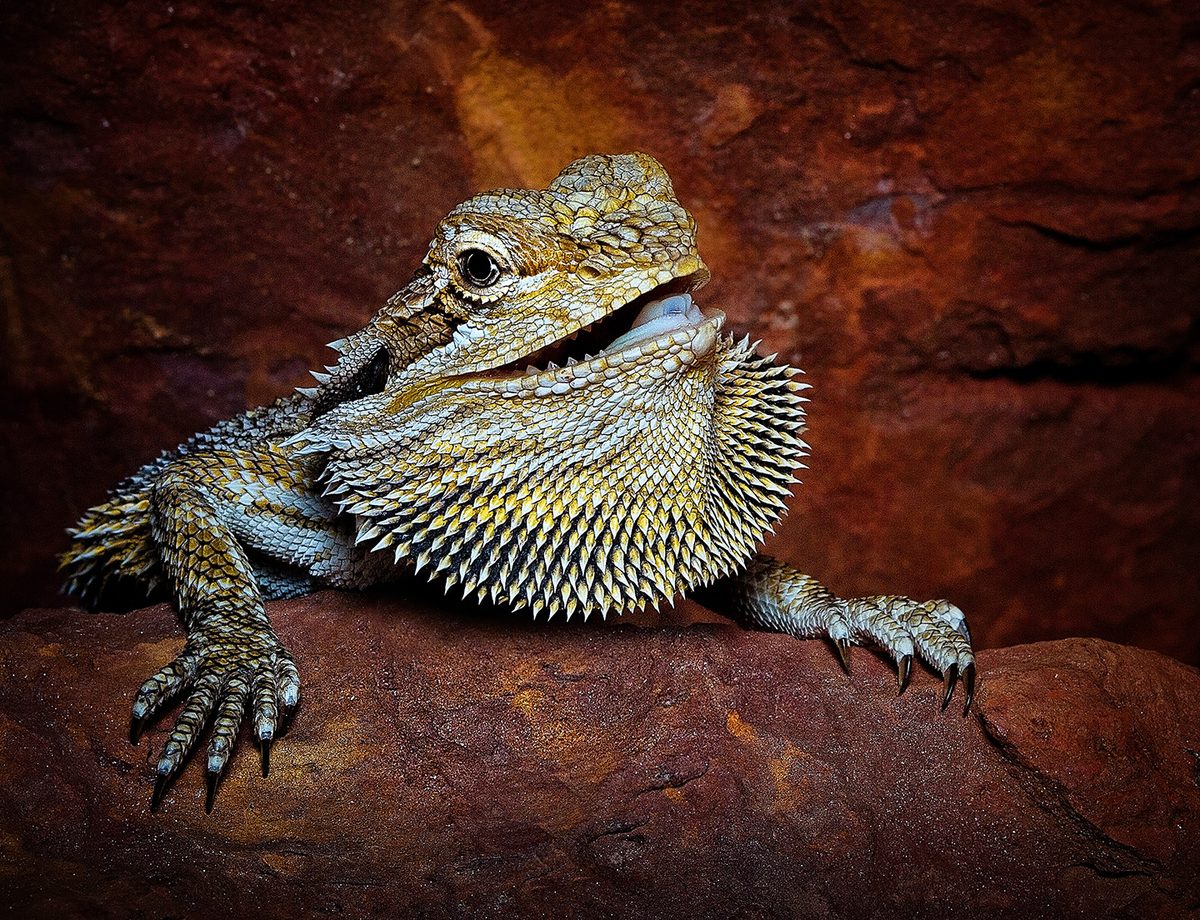

On the fence post at the edge of the paddock, something was arguing without saying a word.
Two bearded dragons, both about 40 centimetres from nose to tail, sat three posts apart in the flat Australian sun, and neither one had made a sound.
The older dragon lifted his head, once, sharp and certain, and held it there.
This post is mine.
The younger dragon understood him perfectly. Not because dragons speak the way people do, but because they speak with their bodies, and every dragon learns that grammar before it learns almost anything else.
She lifted one front leg and moved it slowly, round and round, like a small patient wheel.
I am no threat.
The older dragon watched the wave finish, and did not bob his head again. She had answered correctly. That was the whole conversation, and it had cost nobody a single bite.
She climbed down and found a lower branch instead, close enough to bask, far enough to be polite, and there she caught the morning sun and let her beard, that ring of pointed scales beneath her chin, lie soft and pale against her throat.
When she was truly annoyed, that beard would darken and puff wide as a collar. This morning gave her no reason for it.
She spent the day the way a bearded dragon spends most days. Insects when she found them, quick and easy. Flowers and soft new leaves when she did not feel like hunting. Once, a fallen piece of fruit, sweet and already warm from the sun.
Weeks later, she dug a burrow in loose sand at the base of a termite mound and laid a clutch there, somewhere between 15 and 30 eggs, then covered it over and left it, the way her own mother had left her.
That patch of sand sat squarely in the afternoon sun, and it grew very hot.
Inside each shell, an egg was becoming a dragon, and each one carried its own chromosomes, quietly deciding whether it would hatch male or female.
But heat has its own opinion. In the hottest eggs, heat won the argument, and some hatchlings that carried a male's chromosomes came out of the sand as females anyway, warmed into it by the sand around them.
Nobody watching the nest that day could have told which was which. A hatchling is a hatchling, small and quick, already lifting one leg to wave at its nearest neighbour before it had even found its first insect.
The seasons turned, as they always do in that dry country, and when the cool months came, the whole colony went quiet together. No basking. No waving. No head bobs across the fence line. Just stillness, tucked into burrows, waiting out the cold the way bearded dragons always have.
Spring woke them the same way it always does.
The fence posts filled again, and along that same stretch of paddock, dragons old and young settled into their places, one wave and one bob at a time, without a single argument turning into anything worse.
Some of what decided who they became had come from the sand itself, warm and patient, asking a question no chromosome could answer alone.
The rest, they worked out together, one slow wave at a time.