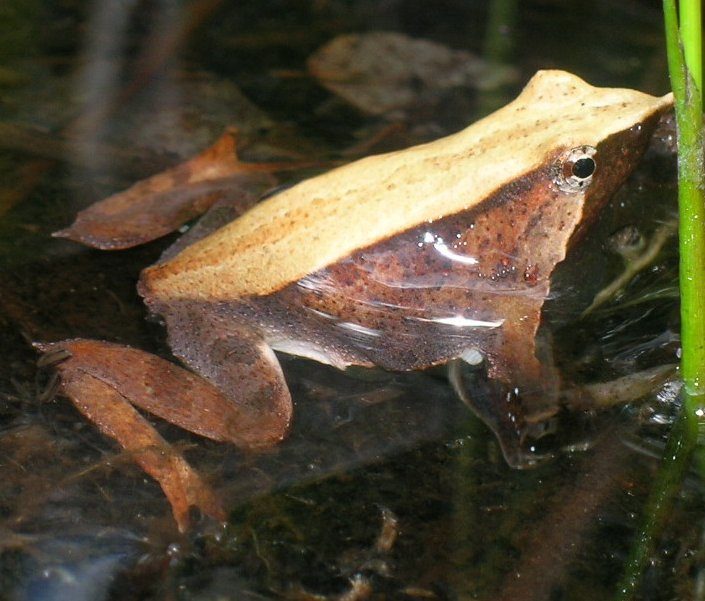

Nobody in the forest noticed the frog on the leaf litter, because nobody was supposed to.
He was about three centimetres long, brown as a dead leaf, with a nose that came to the same soft point as the leaf tip beside him. When the wind stirred, he did not move, and the whole forest floor of southern Chile went on rustling around him as if he were not there at all.
That was the plan.
Between egg and hatch, he still hunted small insects along the leaf litter, quick flicks of his tongue that the forest never noticed either.
Nearby, the mother had laid her eggs on the damp moss days before, small and clear and patient. Now it was his turn to wait.
He stayed close, day after day, while inside each egg a small shape curled and grew. If anything came near, a beetle too curious, a shadow too low, he simply lay still, and if that was not enough, he flipped onto his back and stopped moving altogether, playing so convincingly dead that most hunters lost interest and moved on.
Watch.
Wait.
Do not be seen.
Then one damp morning, the eggs began to wriggle.
He leaned close, and one by one, he opened his mouth and took the small trembling shapes inside, not to eat them, but to keep them, tucking each one down into the pouch beneath his chin where his own voice usually lived.
For a while, nothing about him looked different. He still sat among the leaves exactly as before, still vanished into the litter the moment anything moved.
Then his throat began to swell.
A beetle crossing nearby paused at the sight of him, this ordinary leaf-colored frog with something round and alive shifting under his chin, and scuttled the long way around instead.
He did not croak in those weeks. He could not. His voice was busy being a nursery, and the tadpoles inside him grew on nothing but what their own eggs had already given them, safe from the wet cold and from hunters who never learned to look twice at a leaf.
Six weeks passed. Then seven.
By the eighth week, his throat had grown so full that he could barely close his mouth around it, and the forest that had never once looked at him twice would have been astonished to know what he carried.
One morning, he opened his mouth, and out came a frog no bigger than a fingernail.
Then another.
Then another, each one perfect and small and ready, hopping off into the moss where their father had once lain so still that the world forgot to look for him.
He watched them go, one by one, into a forest that still has fungus and shrinking trees to worry a small frog, and he did not follow. His part was finished.
He simply sat back down among the leaves, folded his legs, and let his pointed nose blend once more into the leaf litter, an old trick, freshly proven, waiting for whatever the forest asked of him next.