
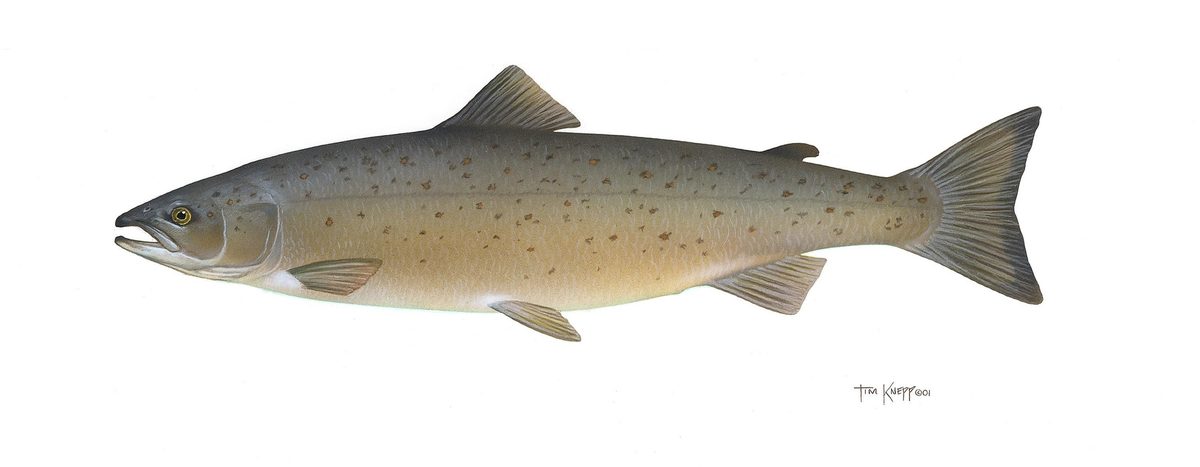

Something in the water had started to feel wrong to her.
Not dangerous. Just wrong.
For years the cold feeding grounds near Greenland had been enough. Wide grey water. Slow patient circles. Meal after meal, until she carried somewhere between three and ten kilograms of good silver muscle, more than she had ever weighed as a young fish in a river.
Then, one season, the wrong feeling won.
She turned toward the coast and did not turn back.
Long before this, when she had been small enough to hide under a single stone, she had lived in a river of clean gravel, in water that carried its own smell, layered with minerals and moss and rain that fell nowhere else on Earth. She had turned silver and swum out to sea as a smolt, and she had not smelled that water since.
Now she followed it home.
Not by sight. The open ocean gave her nothing to look at that pointed the way.
By smell.
She carried the memory of that one river the way a person carries their own name, without ever needing to be reminded of it.
Thousands of kilometres passed beneath her. Coastlines she did not recognise. Then, at last, water that smelled faintly, distantly, unmistakably right.
Close to shore, her body changed its mind about food.
She stopped eating.
Everything she had left would be spent on the river instead.
The current grew stronger the further up she swam, and in the shallows she passed a male who had grown a hook at the tip of his lower jaw that season, built for holding his ground, not for hunting. He let her pass.
Then the river gave her its hardest question: a wall of white water, falling from somewhere she could not see the top of.
She watched it first.
She read where the water curved, where it slowed, where a fish might find one moment of lift.
Then she waited for the surge that would carry her highest.
She leapt.
The falls rose about three metres above the pool, and the first attempt fell short. So did the second.
The third time, she cleared it.
Above the falls the water grew shallow and clear and achingly familiar, gravel bright underneath her, and something in her simply knew this stretch of river the way she had known nothing else in the whole ocean.
She had found the place.
There, she turned on her side and swept her tail through the gravel, again and again, until she had dug a hollow the current could not fill in. Into it she laid her eggs, and the male with the hooked jaw guarded the water around them while she covered the hollow over, stone by stone.
Some Atlantic salmon never leave that river again.
She might.
Thin and worn from the journey, she drifted back down toward the sea, carrying just enough strength to try the whole return one more time, one more year.
The gravel settled over the eggs, and the stream ran on above them, holding the same scent it always had.
Somewhere out at sea, that scent is already waiting for whoever comes looking for it next.
Some travellers need a map.
She only ever needed a memory.