
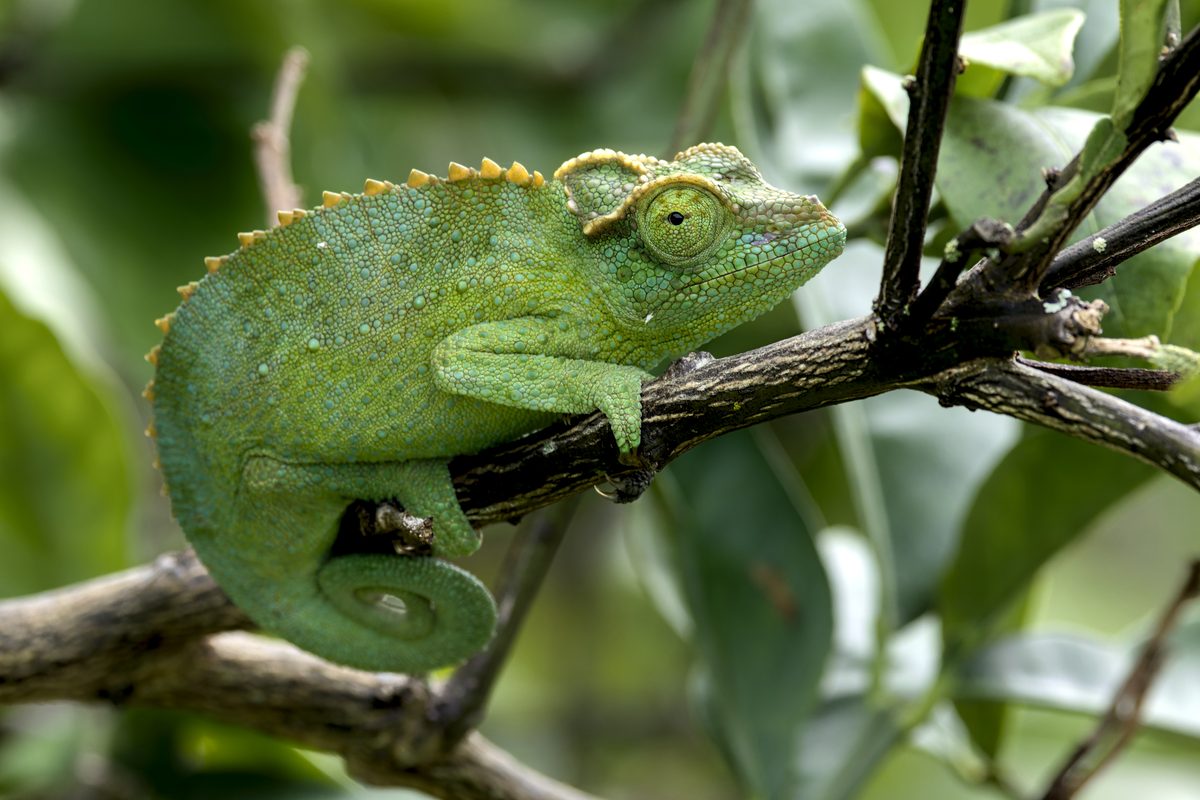

Something was missing from the young chameleon's face.
Every grown male on the misty mountain slope wore three horns, one over each eye and one on the nose, sharp enough to catch the fog-light like tiny spears. He had three soft bumps instead, barely more than a promise.
No one made room for bumps.
He climbed toward the best branch in the whole tangle, a fine damp perch bearded in lichen, exactly where the morning sun found the mist first. An old male already held it, horns high, and when the two of them met, the old male leaned in and pushed. Not hard. Just enough.
The young one slid backward off the branch and caught himself on a lower one, and that was that.
Cool mountain air is a patient kind of place, and he learned to live in it slowly. His left eye found a beetle on one side of the trunk while his right eye, moving on its own, checked the fog behind him for hawks. Two directions at once, two decisions at once, and neither eye ever waited for the other.
When a fly settled just out of easy reach, he did not creep closer. He held still, aimed, and let his tongue do the work, a length longer than his whole body, gone and back before the fly had finished landing. His feet, shaped like two small tongs on each foot, never once slipped on the wet bark while he waited.
He drank the same patient way, from the mist itself, licking the beads of dew that gathered on every leaf each morning, because up on the mountain a stream is often further than a thirsty chameleon wants to travel.
Season after season, the bumps above his eyes lengthened.
The first spring, the old male on the good branch did not bother to lean anymore. He simply glanced over, and went back to sunning himself.
The young one noticed that before anyone announced it.
The second spring, when he climbed the same trunk, he found the branch empty. The old male had moved to a lower perch and did not come back to challenge him for it.
No one pushed. No one needed to.
By the time his horns had grown long and true, three of them, curved and pale as the old male's had once been, he had a fine damp branch of his own, and a female had chosen to share the fog-light beside him.
He expected the long wait that other lizards keep, weeks of guarding a hidden clutch of eggs against every hungry thing on the mountain.
It never came.
One cool morning, instead, the babies simply arrived. Not from eggs buried in the earth, but from her, one after another, tiny and complete, each one finding a twig and closing its small tonged feet around it within moments of being born.
Twenty of them, then more, scattered across the wet branches like a second color shift on a family that already changed color with every mood and every degree of warmth.
He watched them find their grip, steady themselves, and go still, waiting the way he had once waited, for whatever came next.
Not one of them wore horns yet.
Every one of them would, in their own patient season.