
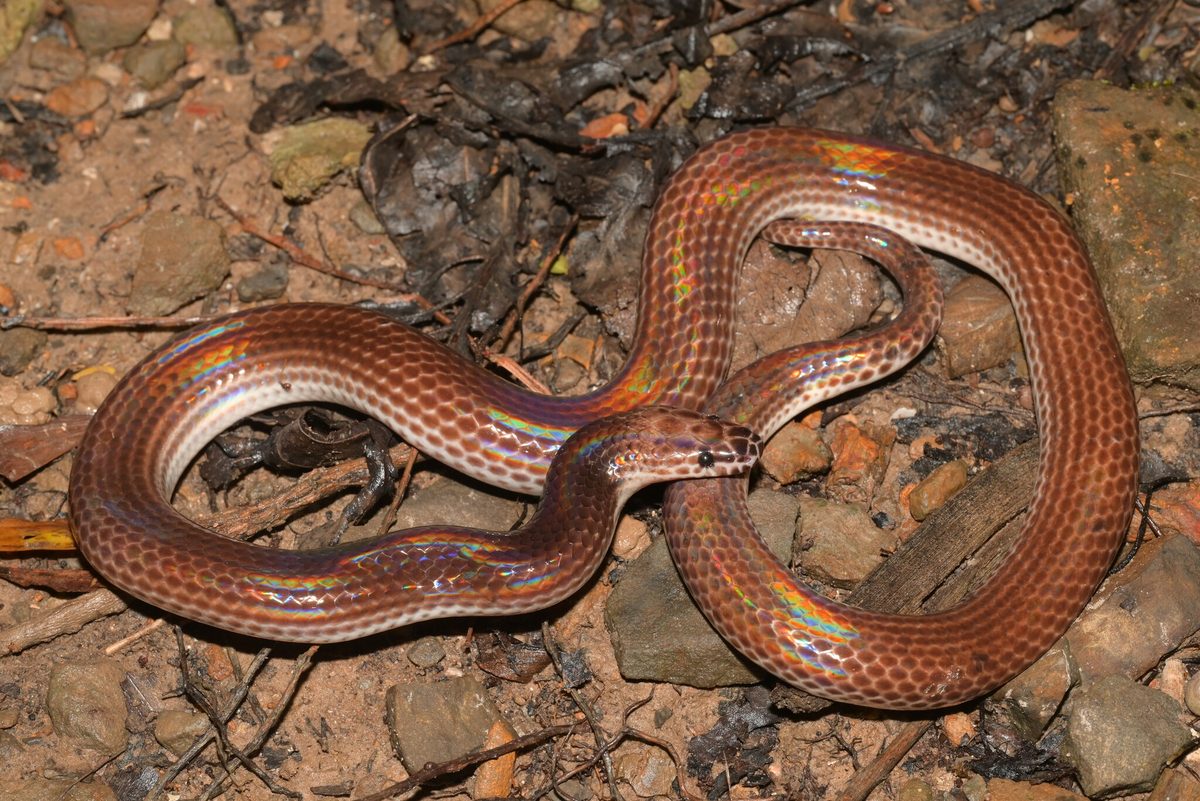

In the flooded rice paddies of Southeast Asia, something in the mud looked like nothing at all.
A length of dark. Plain. Easy to miss. Easy to forget.
The farmers who worked the paddies barely glanced down when she passed beneath the water, parting the soft mud with a head shaped like a wedge, built for pushing through earth the way a plow pushes through a field.
She was a sunbeam snake, about a metre long, one of only two kinds of snake built quite like her anywhere in the world. By daylight, she agreed with everyone who ignored her. Plain suited her fine.
Underground was where she did her living.
She felt her way through soft soil and root and worm burrow, one slow push at a time, and the world she needed was small and warm and dark.
At dusk, she came up.
This was the hour the frogs sang loudest, unaware that the singing gave them away. This was the hour the lizards moved slow with the cooling air, and the small mice grew careless, and even other snakes, thinner and quicker than her, sometimes crossed her path and did not cross it twice. She wound around what she caught, patient and firm, the old constrictor's way, and held on until it was time to let go.
Nobody needed to fear her. She had never once bitten a person, and never once needed to.
One evening, a heron stood at the paddy's edge, watching the water for its own dinner, when a length of nothing at all rose from the mud in front of it.
The heron did not know, at first, what it was looking at.
Because the low sun had found her.
Every dark scale had turned. Purple sliding into green, green sliding into a deep, wet blue, the whole length of her rippling like oil laid across still water. The heron lifted one long leg and stepped back, startled by a snake it had walked past a hundred times.
She kept moving. She was already hunting.
Word travels slowly across a rice paddy, but it travels. A farmer's daughter, wading home along the bund at dusk, stopped one evening and pointed.
"There," she said. "The rainbow one."
Her mother had only ever called it the plain snake, the harmless one, the one that never bit and never needed to. But the daughter had seen what the light does to a sunbeam snake at exactly the right hour, and after that evening, she watched for it on purpose.
She laid her eggs in the warm soil she knew best, and went back to her slow, dark, underground life, and most days nobody thought of her twice.
But some evenings, when the light came in low and gold across the paddies, the ground itself seemed to catch fire for a moment. A color nobody had painted there. Gone again before anyone could point a second time.
Shed her skin, and the color goes with it.
Somewhere under the mud tonight, a plain dark snake is waiting for the one hour that was never really about being seen.
It was always about being warm, and fed, and alive.
And once a day, for a few minutes only, alive looked exactly like a rainbow.